
Skip to content
Subscribe
Technical postmortems

A three-part postmortem

The Cuegence Postmortem

A startup that never failed, because it was never built. Ten days from a beautiful engineering problem — longitudinal models of how children actually learn — to the decision not to spend three years on it.

Format
3 connected essays
Arc
Problem to market to lesson
Audience
Founders and engineers who fall for problems
An intricate learner-model graph on one side and the commercial reality of budgets, integrations and sales calls on the other, funnelling into a kill decision.

The whole company, by the numbers

days
10 From first idea to kill decision
definitions
3 Product definitions, each better than the last
schools
6 Decision-makers asked what they would pay
production systems
0 One prototype component. No customers to disappoint.

The basic gist

The postmortem in one minute

Schools store marks. They don’t store the learning journey between them. Cuegence was going to model that journey continuously — and it was a genuinely good engineering problem. That turned out to be the dangerous part.

  1. 1

    Cuegence was a longitudinal model of learning — curriculum graphs, evidence provenance, memory decay, revisable understanding — and technically it still deserves to exist.

  2. 2

    Six ten-minute calls with the people who sign purchase orders produced three zeros, two ₹50,000-a-year offers, and one “only if it replaces my ERP”.

  3. 3

    Every market objection can be re-read as a product problem; that is exactly how founders spend years fixing the product instead of the business.

  4. 4

    Distribution and demand are different problems — real channel access only makes it cheaper to hear “no” at scale.

  5. 5

    Stopping is execution. Ten days from first idea to kill decision was the cheapest possible version of this lesson.

The conversation that decided it

“If this product existed, how much would you pay for it?”

Six decision-makers. Ten minutes each. No demo, no pilot, no extended needs analysis — and no negotiation either, which was the answer.

  • Three schools

    Nothing. We don’t need it.

    The problem itself was not important enough to them.

  • Two schools

    ≈ ₹50,000 per year.

    Enterprise-style complexity attached to small-business contract values.

  • One school

    ₹100 per student per month — if it replaces my ERP.

    The most useful answer of all: it named the budget line we were not on.

Six short calls are not customer discovery by any respectable standard. Startup decisions don’t require mathematical proof, though — only enough evidence to decide where to spend finite years. Part II is the full account.

How it fits

One decision in three stages

The engineering problem creates the excitement. The market answers it. The third part is what remains once both are true.

  1. Part 1 The problem
  2. Part 2 The market
  3. Part 3 The lesson

The complete postmortem

Read it in the order it happened

Every part stands alone, but the argument only lands in sequence: fall in love with the problem, take it to the market, then decide what the answer means.

  1. A teacher at a desk surrounded by projected panels showing a curriculum graph, evidence sources and an evolving learner model, illustrating the shift from episodic marks to a continuous picture of learning.
    Part 1 The problem

    I Fell in Love With the Engineering Problem

    Schools store marks, not the learning journey between them. The idea, the curriculum graph, the probabilistic learner model, and the hard constraints that made the system feel serious — and made it easy to skip the commercial question.

    Start here for the idea and the architecture that seduced it.

  2. A classroom overlaid with per-student learning cards, a concept graph and teaching-copilot panels, illustrating the product that was taken to six schools.
    Part 2 The market

    Six Schools and an Uncomfortable Answer

    Three pivots — dashboards to teaching copilot to invisible infrastructure — then one blunt question asked to six decision-makers: if this existed, how much would you pay? The answers, the integration tax, and why the market kept moving without ever converging.

    For anyone validating a B2B idea before building it.

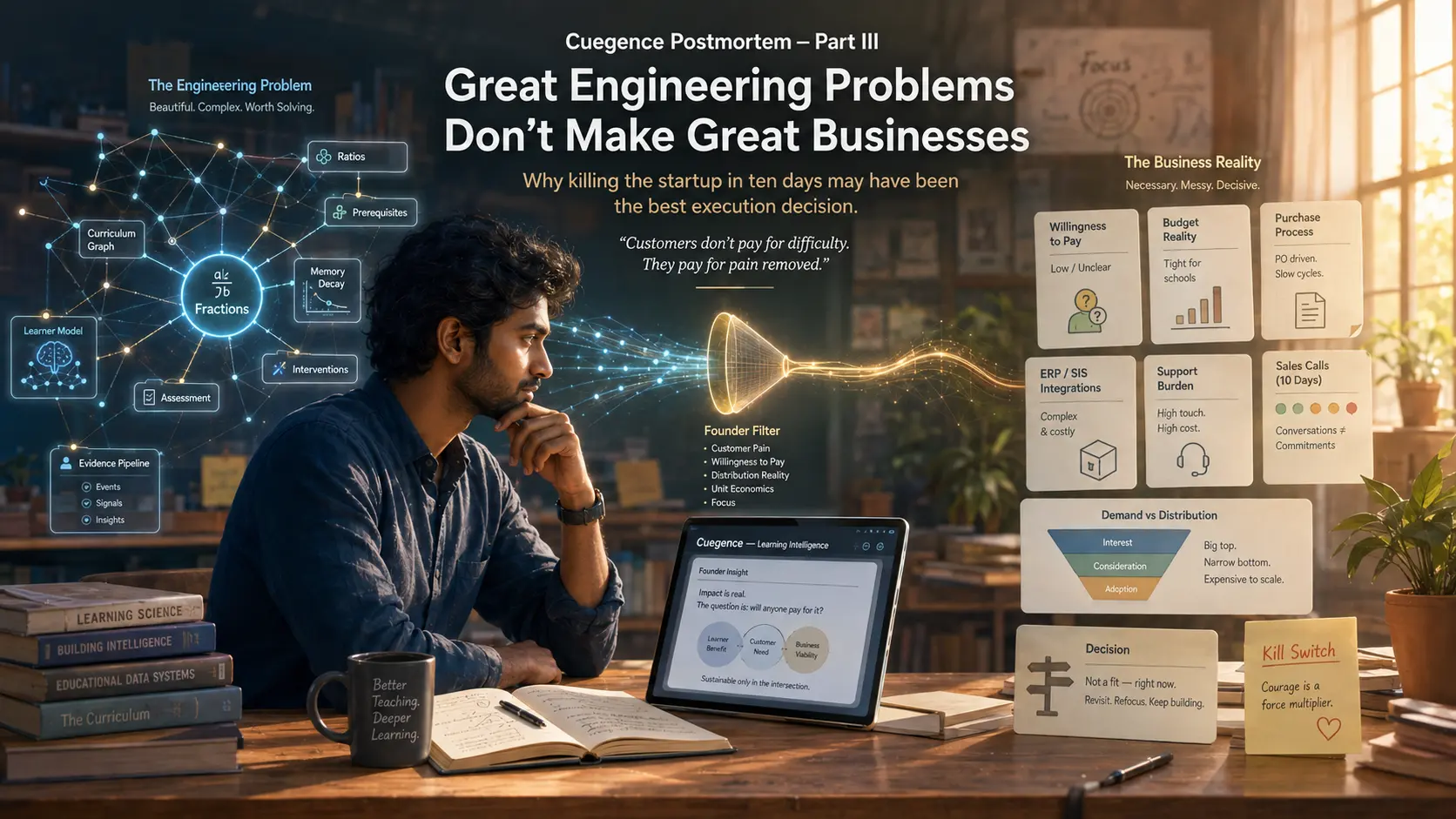
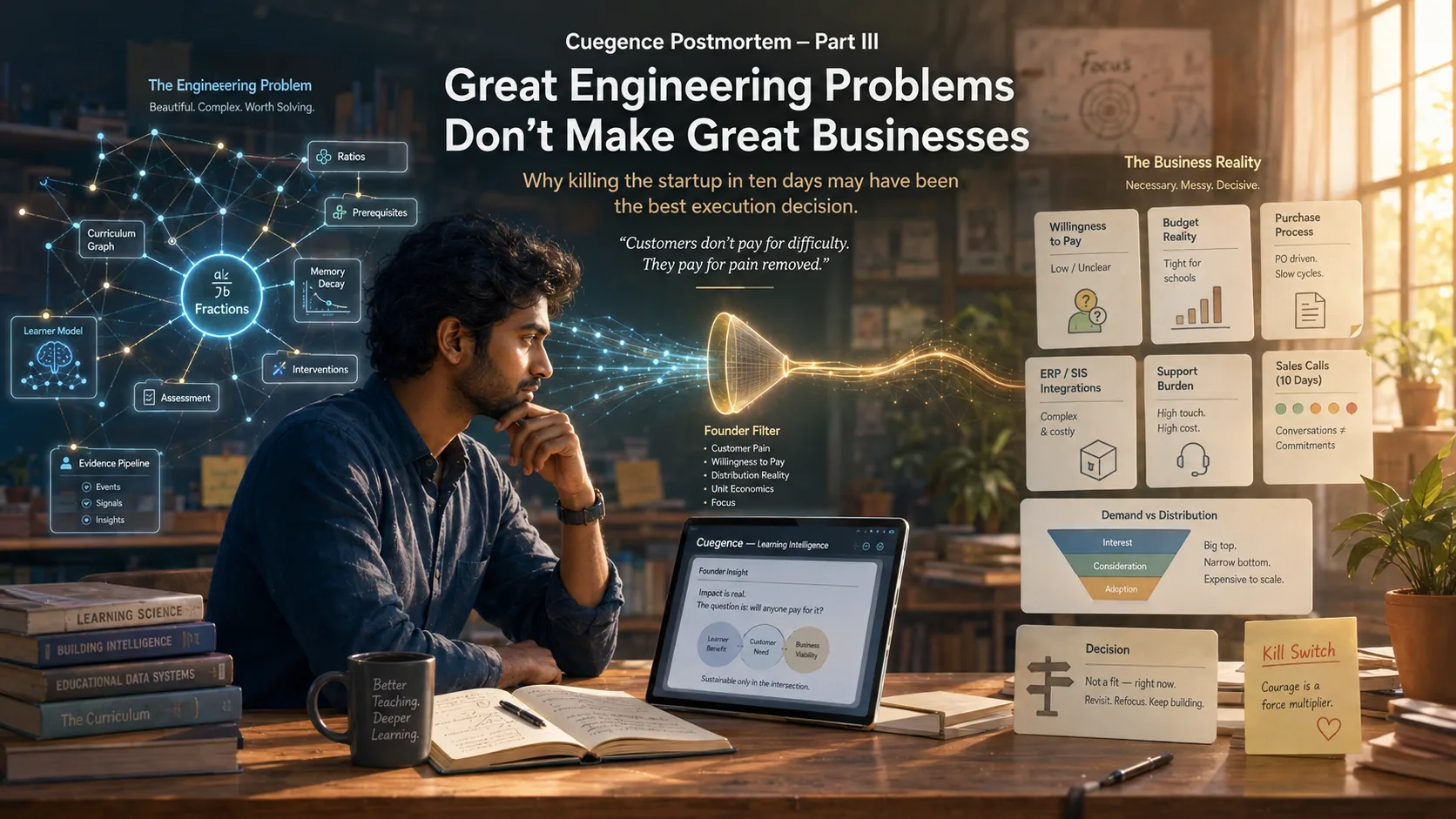
  3. An intricate learner-model graph on one side and the commercial reality of budgets, integrations and sales calls on the other, funnelling into a kill decision.
    Part 3 The lesson

    Great Engineering Problems Don’t Make Great Businesses

    The budget line, the replacement question, the moat that never appeared, and a distribution channel that could not manufacture urgency. Why killing the company in ten days was the successful outcome — and what still refuses to be resolved.

    The lessons, for founders and engineers who fall for problems.

Already know what you came for?

Enter wherever your question is

The systems design, the customer conversations, or the decision itself — pick the door and keep reading forward.

Sometimes the smartest thing you can build is the conviction not to build it.

Cuegence still deserves to exist. That is not the same as it deserving the next three years of one person’s life — and telling those two things apart took ten days.

Begin Part I