AI-Native Software Engineering Isn’t About AI
AI-native engineering isn't about how much AI you use. It's a development model where AI is a primary participant in building software, not an assistant.
On this page
- From assistance to inversion
- A brief terminology note
- Why vibe coding is the wrong reference point
- Implementation was expensive; ambiguity still is
- What context architecture looks like in practice
- The engineer as orchestrator
- The competency stack is being reordered
- This is not the end of software engineering
- What should you change on Monday?
- Audit one recent ticket for hidden assumptions
- Add repository context for one recurring pattern
- Require a plan before implementation
- Separate generation from approval
- Measure review burden, not generated volume
- The productivity question is harder than it appears
It is about changing what software engineers actually do.
For most of the history of software development, writing code was the most visible and time-consuming part of building software. An engineer received a requirement, translated it into a technical design, and then expressed that design through functions, classes, database queries, API calls, configuration files and tests.
That relationship is beginning to change.
An increasing number of engineers now spend less time producing every line themselves and more time describing a change, providing context, reviewing a plan, supervising an agent and validating the resulting implementation. The repository still contains code, tests and pull requests, so from the outside the process may not appear fundamentally different. It is tempting to describe this as ordinary software development made faster by better tools.
That description misses the more important shift.
AI coding systems are not merely reducing the time required to type an implementation. They are changing the division of labour between the engineer and the machine. The machine is taking on more of the mechanical work of constructing software, while the human is being pushed toward specification, architecture, judgement and verification.
The engineer is moving upward in the system.
This is the idea at the centre of AI-native software engineering. It is not defined by how many AI subscriptions a company buys or whether developers have a chat window inside their editor. It describes a development model in which AI becomes a primary participant in software construction rather than an occasional assistant.
That changes what the engineering process optimises for, which skills become valuable, and where quality failures are likely to emerge.
From assistance to inversion
Most organisations currently operate somewhere between AI-enabled and AI-assisted development.
In an AI-enabled organisation, developers occasionally use a general-purpose model to understand an error, generate a query or draft documentation. Usage is individual and optional. The company’s engineering process remains unchanged.
In an AI-assisted organisation, AI is embedded more deeply into the workflow. Developers rely on autocomplete, code chat, test generation and repository-aware editing. They may ask a tool to create a function, refactor a class or identify the cause of a failing test. The engineer still remains the primary author, while AI provides tactical support.
AI-native engineering reverses this relationship.
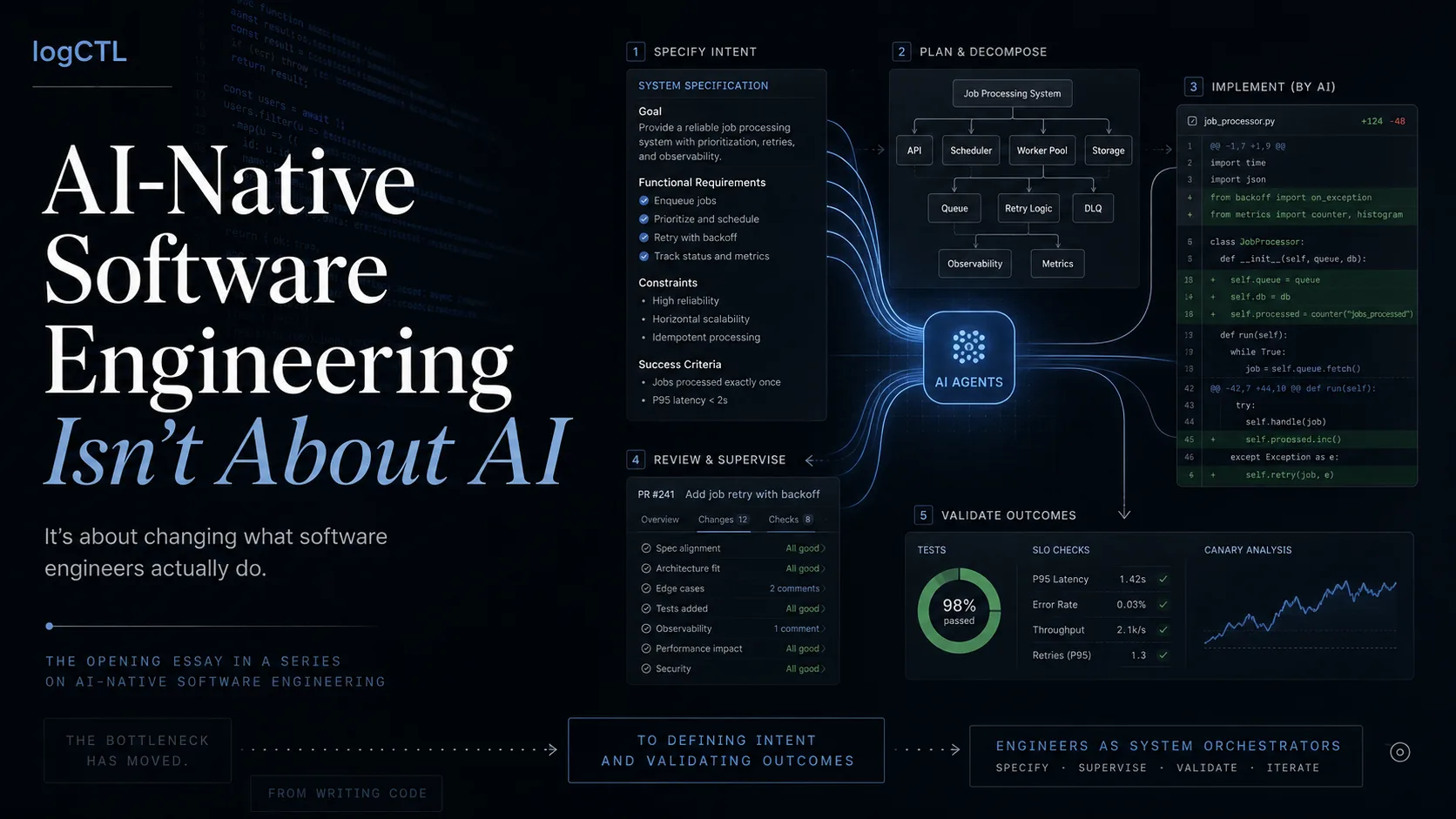
The engineer defines the goal, constraints, architecture and expected behaviour. An agent inspects the repository, proposes a plan, modifies multiple files, runs commands, executes tests and prepares a change for review. The human remains responsible for the outcome but no longer performs every implementation step manually.
In AI-assisted engineering, the human produces and the AI assists. In AI-native engineering, the AI produces and the human directs.
The research behind this article describes the shift as an inversion of the default relationship. When AI becomes the default generator, the human role increasingly centres on guiding, specifying and validating. The competency stack moves away from syntax mastery, API memorisation and raw implementation speed, and toward requirement decomposition, specification precision, context architecture, validation methodology and system-level reasoning.
This does not make implementation knowledge obsolete. An engineer cannot reliably review code they do not understand, and they cannot identify architectural mistakes without knowing how systems are built. What changes is the relative value of those capabilities.
Writing an implementation remains useful. Determining whether an implementation should exist in its current form becomes more important.
The productivity equation changes with it. Traditional development often rewards some combination of implementation speed, available engineering time and code quality. In an AI-native workflow, output is better understood as the product of specification clarity, AI capability and validation rigour.
A powerful model given vague instructions and weak review can create a great deal of code while producing very little durable value. A disciplined engineer working from a precise specification may achieve far more with the same model.
The bottleneck has moved from producing code to defining intent clearly enough that code can be produced correctly.
A brief terminology note
The phrase AI-native is commonly used in two ways.
It can describe AI-native engineering, where agents participate in building software, or AI-native products, where models and probabilistic behaviour are part of the product’s architecture.
The two are related but distinct. A team can use agents to build a conventional payroll system, just as a traditional team can build an AI-powered product.
This article is about the first meaning: what happens when AI becomes part of the engineering workforce itself.
The distinction matters because tool adoption is often mistaken for process transformation. Giving every developer access to an AI editor does not make an organisation AI-native. A genuinely AI-native workflow must be designed around the capabilities and limitations of agents.
Requirements must be legible to both humans and models. Repositories must contain explicit architectural and behavioural context. Tasks must be decomposed into units that can be delegated safely. Permissions, tests and review gates must exist before agents are allowed to act broadly.
AI-native engineering is therefore not defined by the presence of AI. It is defined by the operating model built around it.
Why vibe coding is the wrong reference point
Much of the public conversation about AI-generated software has been shaped by the phrase vibe coding. The term captures a real and often enjoyable experience: a person describes what they want, the model produces something, errors are fed back into the conversation, and the process continues until the application appears to work.
For prototypes, experiments and disposable tools, this can be enormously valuable. Ideas that once required days of setup can be explored in an afternoon. Someone with limited programming experience can create a working demonstration. An experienced engineer can test whether a product concept deserves further investment.
The problem begins when this style of work is confused with production engineering.
A prototype only needs to demonstrate that an idea can work. A production system must remain correct while the idea changes. It must survive partial failures, unexpected inputs, security threats, migrations, operational incidents and years of accumulated modifications.
A system that appears to work today may still be insecure, difficult to operate or impossible to maintain.
The defining feature of vibe coding is therefore not that AI wrote the code. It is that human comprehension is treated as optional.
That is very different from professional agentic engineering.
An AI may write every line of a change without the work becoming vibe coding, provided an engineer understands the important decisions, reviews the implementation, validates the behaviour and remains accountable for shipping it. Conversely, a developer can manually paste generated snippets into a codebase without understanding them and create exactly the same risk.
The relevant question is not who typed the code. It is whether anyone can responsibly stand behind it.
The distinction is practical, not philosophical. The research report cites incidents involving exposed personal information, an agent deleting production data despite explicit instructions, and analyses finding substantially higher rates of major and security issues in AI-co-authored contributions.
These examples do not prove that AI-generated code is inherently unusable. They demonstrate that generation without comprehension, supervision and control is not a production methodology.
AI-native engineering begins where blind generation ends. It treats generated code as a draft rather than as a decision. It assumes that plausible output may still be architecturally wrong, that passing tests may provide incomplete evidence, and that a clean diff may solve the wrong problem.
The goal is not to trust the model more. The goal is to build a process in which misplaced trust is unnecessary.
Implementation was expensive; ambiguity still is
Consider a fairly ordinary requirement:
When a payment succeeds, activate the learner’s enrolment, generate an invoice, send a confirmation and ensure retries cannot produce duplicate records.
A competent engineer can understand the general intention almost immediately. Implementing it correctly, however, may involve learning how payment events enter the system, which service owns enrolment state, how invoices are numbered, whether email delivery happens synchronously, how retries are managed and what identifier should be used for idempotency.
The engineer must also decide what happens when invoice generation succeeds but notification delivery fails, or when the payment provider sends the same event twice.
Historically, much of this reasoning happened inside the engineer’s head while the code was being written. The implementation process and the problem-solving process were tightly intertwined.
An agent can now perform much of the mechanical implementation. It can locate related classes, create migrations, add a queued job, write tests and update the event handler. But it cannot reliably infer every unstated organisational decision.
Which event represents a final payment rather than an attempted payment? Is the invoice service allowed to regenerate an invoice? Should a failed email prevent activation? What information may be logged? Which identifier makes a retry safe?
These are not prompting tricks. They are engineering decisions.
AI makes a long-standing truth easier to see: code was never the entire problem. It was the final expression of a large number of assumptions, constraints and design choices.
When implementation was slow, vague thinking was often corrected during coding. The engineer encountered contradictions, asked questions and adjusted the design while working through the details. When implementation becomes nearly instantaneous, the code may appear before those contradictions have been discovered.
This creates an illusion of progress. Hundreds of lines can be generated in minutes, but a single incorrect assumption may make the entire change unusable.
The new constraint is not whether the system can generate an implementation. It is whether the organisation can communicate enough intent and context for that implementation to be trustworthy.
What context architecture looks like in practice
“Provide better context” is easy advice to give and difficult advice to apply.
Suppose an engineer asks an agent:
Add rate limiting to the login API.
The agent may inspect the route, choose a common library, add middleware and write a basic test. The change may look completely reasonable.
But the repository may already use Redis-backed rate limiting through a shared security package. The organisation may distinguish between account-level and IP-level limits. Internal traffic may require a separate policy. Security events may need to be recorded through an audit service rather than ordinary application logs.
Without that context, the agent is likely to create a locally correct but organisationally wrong implementation.
Bad context might consist of a generic instruction such as:
Follow best practices and use clean architecture.
That tells the agent almost nothing.
Good context would be specific and behaviourally anchored:
Authentication endpoints must use the shared
LoginThrottleservice inpackages/security. Do not add framework-native throttling middleware. Apply limits by both account identifier and IP address. Record lockout events throughSecurityAuditLogger; never include passwords, tokens or full request bodies in logs. Follow the implementation inPasswordResetControllerand update its contract tests when changing shared behaviour.
The difference is not prompt cleverness. It is the conversion of institutional knowledge into explicit, reviewable engineering context.
This context may live in repository-level instruction files, architecture decision records, scoped rules for specific directories, examples of approved patterns and explicit lists of prohibited approaches. The research report identifies mechanisms such as AGENTS.md, CLAUDE.md, .cursor/rules/, Copilot instruction files and architecture records as practical ways of making a codebase legible to agents. It also argues that context should be treated like code: committed, reviewed and updated alongside the convention it describes.
A mature context system answers three questions before the agent begins:
- What does this repository consider correct?
- Which existing pattern should be followed?
- Which actions are explicitly forbidden?
If those answers exist only in the heads of senior engineers, agents will repeatedly rediscover them badly.
The engineer as orchestrator
It is common to say that AI will turn developers into managers. The comparison is useful, but incomplete.
The emerging role is closer to technical orchestration: coordinating models, tools, repository context, execution boundaries and human review so that a desired outcome moves safely from intent to production.
This is not merely prompt engineering.
Prompt engineering focuses on how a request is phrased to a model. Orchestration covers the wider system in which the model works. It includes deciding which tasks should be delegated, what context should be loaded, which model is appropriate, what tools may be used, where human approval is required and what evidence is necessary before the result can move forward.
A normal day for an engineer in this environment might look like this:
A product requirement arrives in the morning. The engineer first removes ambiguity, identifies edge cases and turns the request into acceptance criteria. They ask one agent to inspect the existing architecture and produce a change plan, while another analyses likely security and migration risks. The engineer reviews both, resolves contradictions and narrows the implementation scope.
The implementation agent then works inside a restricted branch or worktree. It can edit relevant files and run tests, but cannot access production credentials or deploy anything. When the implementation is ready, review agents check the diff against architectural rules, security requirements and the original specification. The engineer examines the areas where those reviews disagree, tests the behavioural assumptions and decides whether the change is ready for human approval.
The work is still software engineering. But instead of manually executing every transformation, the engineer designs and supervises the transformation pipeline.
This is a new layer in the software development lifecycle. It sits between intent and implementation, coordinating agents in the same way a build system coordinates compilers, tests and deployment steps.
The faster generation becomes, the more important this orchestration layer becomes.
Imagine ten capable agents each producing an implementation within five minutes. That sounds like a dramatic productivity improvement until their changes need to be reviewed, reconciled and integrated.
Someone must ensure they did not solve overlapping problems in incompatible ways. Someone must identify duplicated abstractions, conflicting migrations and architectural drift. Someone must determine whether local correctness has created global complexity.
The organisation has not removed work. It has moved the work into coordination, judgement and verification.
The competency stack is being reordered
Software engineering has traditionally used coding ability as both a practical skill and a proxy for competence. Interviews test implementation speed. Training programmes emphasise writing progressively more complex applications. Developers establish credibility by demonstrating how independently they can turn an unclear requirement into working code.
These capabilities remain useful, but they are no longer sufficient.
In an AI-native environment, engineers need to become better at making decisions explicit. They must convert broad requirements into statements that can be tested. They must separate independent work from tightly coupled work. They must understand what context an agent needs and what should be withheld. They must design validation processes that expose errors before production.
Five capabilities become especially important:
- Specification precision: describing desired behaviour in a way that is explicit, testable and resistant to misinterpretation.
- Decomposition: breaking a complex outcome into smaller tasks without destroying architectural coherence.
- Context architecture: supplying relevant conventions, examples, constraints and system knowledge to a model.
- Validation methodology: deciding what evidence would demonstrate that a change is correct, secure and maintainable.
- System-level reasoning: recognising when a locally reasonable implementation is harmful to the wider codebase.
These skills have always separated strong engineers from weak ones. AI simply increases their leverage.
A developer could previously compensate for an unclear ticket by filling in missing details while implementing it. The reasoning remained internal and eventually appeared in the code. An agent cannot reliably recover knowledge that has never been made explicit. It will fill the gaps using patterns that appear reasonable.
Modern models are especially dangerous here because their mistakes do not always look careless. The generated code may be clean, well structured and accompanied by a convincing explanation. It may include tests and follow the framework’s normal style. It may still embody the wrong assumption.
The central capability of AI-native engineering is therefore not persuading a model to produce more code. It is creating a process in which incorrect assumptions become visible before they become part of the system.
This is not the end of software engineering
Every major improvement in the interface to computing has produced predictions about the end of programming.
Compilers reduced the need to think in machine instructions. High-level languages raised the level of abstraction. Open-source frameworks eliminated enormous amounts of repeated work. Cloud platforms turned infrastructure into an API.
Programming changed after each of these shifts, but it did not disappear.
AI is likely to produce a more disruptive transition than many of its predecessors. The economic value of manually producing routine implementation may decline. Some teams may become smaller. Certain categories of internal software may be generated with minimal traditional development. Entry-level work may need to be redesigned.
None of this means software engineering ceases to matter.
Software engineering is valuable because organisations need reliable systems built from incomplete, conflicting and constantly changing ideas. AI does not remove that complexity. It provides a faster way to act upon it.
That can improve a strong organisation. Clear requirements can be implemented faster. Good test suites can guide agents toward safer changes. Mature architectural conventions can be reproduced consistently.
The same acceleration can damage a weak organisation. Vague tickets can produce large but misguided implementations. Poor review practices can allow subtle defects to spread. Weak architecture can be repeated across the codebase at machine speed.
AI amplifies the organisation that adopts it.
Two teams can use the same model and achieve entirely different results because the model is only one part of the engineering system.
What should you change on Monday?
AI-native engineering does not require an organisation-wide transformation programme on day one. It can begin with a few changes to how work is prepared, delegated and reviewed.
Audit one recent ticket for hidden assumptions
Take a feature that was recently implemented and ask how much important information was missing from the original request. Identify the decisions that lived only in the engineer’s head.
Those missing decisions are the beginning of your specification problem.
Add repository context for one recurring pattern
Choose a pattern agents regularly implement incorrectly: authentication, logging, queues, API errors, database transactions or tests.
Document the approved approach, point to a good example and explicitly name the alternatives that should not be used. Commit that guidance to the repository and review it like code.
Require a plan before implementation
For any non-trivial task, ask the agent to inspect the codebase and propose a plan before it edits files. Review the files it intends to change, the assumptions it has made and the tests it expects to add.
Catching a wrong assumption in a plan is cheaper than discovering it inside a polished diff.
Separate generation from approval
Do not allow the same mechanism that creates a change to become the only mechanism that validates it. Use automated tests, static analysis, security checks and independent review. Treat agent-generated code as untrusted until the evidence says otherwise.
Measure review burden, not generated volume
Do not count lines of AI-generated code or suggestion acceptance rates as productivity. Track how long changes take to review, how often they are rewritten, whether defects escape and whether delivery stability changes.
The aim is not to produce more code.
It is to produce useful changes that remain useful.
The productivity question is harder than it appears
AI coding tools feel fast. They remove the blank page, produce working examples quickly and help developers navigate unfamiliar codebases. A task that once required an hour of documentation reading may begin with a usable implementation in seconds.
Developers naturally interpret this as productivity.
But software engineering productivity is not the speed at which code appears. It is the speed at which reliable, useful and maintainable changes reach production.
Once the entire process is considered, the picture becomes less obvious. Generated code still needs to be understood. Pull requests still need to be reviewed. Architectural inconsistencies still need to be resolved. Tests need to be trusted rather than merely present.
A team can produce more code while delivering less value. It can feel faster while review queues grow. It can close tickets quickly while accumulating work that must later be rewritten.
This gap between perceived speed and measured outcomes is one of the most important findings in the current research. A widely discussed controlled study found experienced developers taking longer to complete tasks with early AI tools even though they believed the tools had made them faster. Later work indicates that newer tools may produce better results, but unbiased measurement has become harder because experienced developers are increasingly unwilling to work without AI.
The contradiction does not prove that AI tools are ineffective. It shows that the industry has often measured the most visible part of the workflow while ignoring the rest.
We measured how quickly the implementation appeared.
We did not measure how long it took to understand, review, correct and trust it.
That is the question the next part of this series will examine. If AI-native engineering is a genuine transformation rather than another productivity fad, its value must survive measurement across the entire software delivery system.
The evidence so far suggests that the gains are real, but they are neither automatic nor evenly distributed. They depend less on how much code a model can generate and more on whether the organisation around it can turn that output into durable software.
This is Part 1 of the LogCTL series on AI-native software engineering. Part 2 will examine the productivity evidence, the gap between perceived speed and measured outcomes, and why review is becoming the new bottleneck.
LogCTL Dispatch
New essays, experiments and workflows. No daily noise.
Usually 2–4 emails a month.
Comments
Loading comments…