AI Needs Verifiable Decisions, Not Just Better Explanations
Why the model that discovers a relationship should not always be the system that makes a consequential decision, such as approving a loan.
On this page
Why the model that discovers a relationship should not always be the system that makes the decision.
A few weeks ago, I was discussing tabular foundation models with a director at a large financial institution. I explained how they can learn relationships from data without a separate model being built for every problem.
His concern was not prediction accuracy. He wanted equations.
Even if a model were more accurate, he said, they might prefer a slightly weaker one whose decisions could be independently examined. He wanted to know whether the institution could defend a prediction if challenged, especially if the model had learned to disadvantage particular communities.
I think he was asking the right question. But an equation is only part of the answer.
Predictions become decisions
Imagine a neural network and a simple statistical model assessing the same loan applicant. The network is more accurate on unseen data, but the simple model’s rules are easier to examine.
Which should the bank use? The answer depends on more than accuracy, because a score can quickly become the decision. In the SCHUFA case, the Court of Justice of the European Union treated a credit score as automated decision-making when lenders rely heavily on it.1
Other rules point the same way. The EU AI Act classifies creditworthiness evaluation as high-risk, with those requirements applying from 2 December 2027.23 CFPB guidance in the US has said that complex models do not excuse lenders from identifying the specific reasons for an adverse action.4
That does not make accuracy a mere business metric. A weaker model can reject creditworthy people, and a simpler one can still be unfair. So the trade-off should be measured rather than assumed. As Cynthia Rudin has argued, an interpretable model may perform as well as a black box in many high-stakes settings.5
An explanation is not evidence
Suppose we train a simple model to imitate a neural network, and the two agree on 98% of our evaluation cases. We can now describe the behaviour with readable rules.
But we have only shown that one model approximates another on the cases we tested. We have not shown that they use the same relationships, or what happens in the other 2%. A faithful copy can also preserve a discriminatory pattern.
Three separate questions tend to get blurred:
- Faithful: Does the account match the computation?
- Conformant: Does the process satisfy the stated rules?
- Justified: Is the decision lawful and fair?
Research already shows why the first question matters. Camburu et al. found failure modes in post-hoc explainers, and Laugel et al. showed that counterfactual explanations can reflect model artefacts rather than knowledge from the data.67
Some newer methods build guarantees into the model instead. SelectPFN, for example, makes predictions from sampled subsets of variables, so excluded variables provably cannot affect them.8 That is a real guarantee about inputs, but it does not explain how the selected variables interact or stop them acting as proxies.
An equation is not enough
The director’s equation would help a validator examine a model. It would not necessarily help a rejected applicant. In a 2025 case, the CJEU held that merely providing a complex formula does not satisfy the right to meaningful information. People must be able to understand the procedure and principles actually applied to their data.9
Nor does an equation settle fairness. A readable formula can still use location as a proxy for a protected characteristic. Finding that usually requires testing outcomes across groups, which a black box can also undergo, and it requires demographic data a lender may not hold.
Transparency makes a decision easier to inspect. It does not make the decision right.
Separate discovery from justification
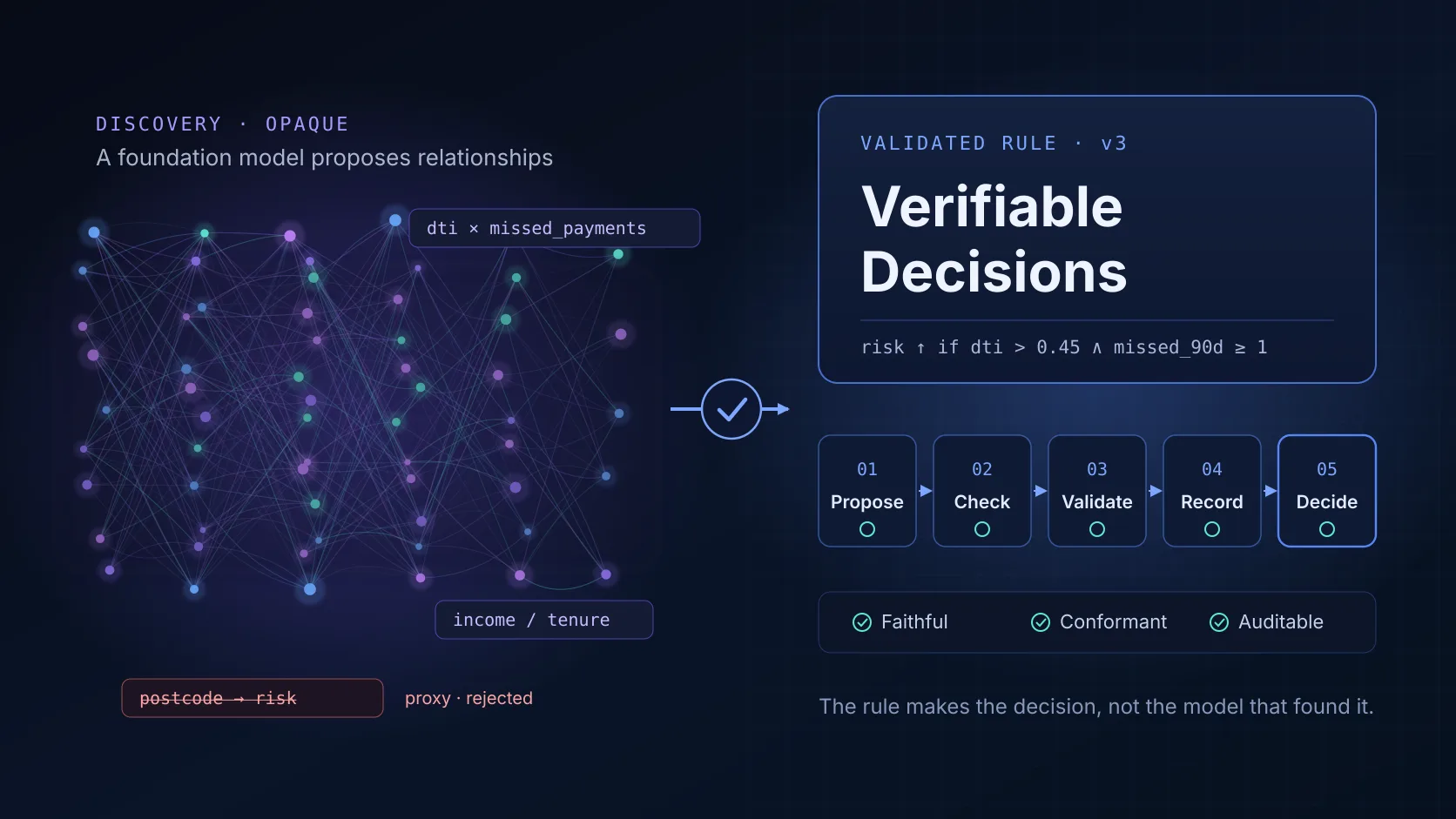
Banks already have inspectable scorecards, so “use interpretable models” is not a new idea. The more interesting possibility is to use a foundation model for discovery, while only a validated rule makes the decision.
How an idea was discovered and why it can be trusted are different questions. The discovery step can stay opaque if the resulting rule stands on its own evidence.
Here is a hypothetical lending pipeline:
- Propose: The model suggests that risk rises when high debt-to-income occurs alongside recent missed payments.
- Check: The system confirms that the rule uses only permitted inputs and is mathematically valid.
- Validate: The team tests the rule on data kept out of the search, then measures outcomes across groups.
- Record: The accepted rule is versioned, along with the policy and evidence behind it.
- Decide: The rule, not the foundation model, produces the outcome, so the applicant can be told which factors applied to their case.
Cases the rule cannot handle go to a person, and that review has to be real rather than a rubber stamp.
This design has its own risks. A model that generates enough candidates may eventually find one that passes by chance, so every candidate should be logged and tested on untouched data. A proxy can also slip through any check nobody thought to write.
The pipeline can make a decision faithful and conformant. Whether it is justified remains a matter for data governance, monitoring and accountable people.
What this changes
Neural networks still have a place in regulated industries, and explainability research still has value. Some problems will not reduce to a concise rule, and some useful signal may go unused.
But for consequential decisions, verifiability should be a design constraint rather than an accessory to prediction. We should measure what that constraint costs, then decide whether a gain in accuracy is worth what we give up in scrutiny.
The goal is a system that does not need to invent an explanation after the decision has already been made.
Footnotes
LogCTL Dispatch
New essays, experiments and workflows. No daily noise.
Usually 2–4 emails a month.
Comments
Loading comments…