Carbon Chooses, Silicon Scales
AI may surpass humans at many kinds of thinking without replacing humanity. The real question is whether that intelligence stays accessible to everyone.
On this page
AI becoming better than us at thinking is not a failure of humanity. It is the reason we are building it.
When I first began using AI for software development, the relationship was very simple.
I gave it the input, the expected output and the logic. It wrote a function.
That was useful, but the intelligence still sat mostly on my side. I had already understood the problem, designed the solution and broken it into an implementation small enough for the model to complete. AI saved me from typing the final expression of my own thinking.
That is no longer how I work.
Now I explain the problem. I discuss possible approaches with AI. We turn the discussion into a plan, and then I let an agent inspect the repository and implement the change within the conventions documented in AGENTS.md or CLAUDE.md. It may modify several files, write tests, run them and correct its own mistakes before I inspect the result.
The obvious conclusion is that AI has become better at coding.
The more interesting conclusion is that my place in the process has moved.
I am spending less time translating a known solution into code and more time deciding what the problem actually is. AI has not simply made the old workflow faster. It has changed the division of thought between the human and the machine.
Watching that transition made me question one of the most common debates around AI: when will it become more intelligent than a human?
I now think the question is badly constructed.
Better at what?
Give an AI system a request to produce a sketch and it can return something in minutes that may take a human artist hours or days. Give a capable coding agent a sufficiently clear requirement and it can generate, test and revise an implementation faster than most people could type it.
On speed and volume of output, the machine has already won in many narrow domains.
Yet the same class of system can misunderstand an ordinary instruction in an absurdly literal way. Earlier image models, asked to put a person “on top of a horse,” would sometimes place them standing or lying on the animal instead of riding it. The words permitted the result. Common sense rejected it. Today’s models rarely fail that crudely, but the failure has not disappeared—it has moved. A coding agent can now satisfy every stated requirement of a ticket while quietly breaking the unstated assumption the whole feature depended on. The literalness survives; only its resolution has improved.
It is tempting to use failures like this as proof that AI does not understand anything. That conclusion is as premature as declaring the model universally intelligent because it produced a beautiful image.
Many such failures are engineering problems, not proven permanent boundaries. Better training data, model architectures, preference tuning and specialised adapters such as LoRAs already reduce them. A weakness in the current generation tells us how the current system behaves. It does not tell us what silicon intelligence can never become.
“Better” only becomes meaningful after we choose a measure: speed, energy efficiency, memory, judgement, learning, originality, scalability or something else.
The human-versus-AI debate often compresses all of these into a single imaginary intelligence score. But carbon-based and silicon-based intelligence were built under radically different constraints. Their strengths are not distributed in the same way, and they do not need to serve the same role.
Carbon is astonishingly efficient—and physically bounded
The human brain is an extraordinary machine. It perceives the world, controls a body, recalls a life, learns, imagines and makes decisions while operating on an energy budget of roughly 20 watts.
That number should be treated carefully. A brain and a GPU do not perform identical operations, so dividing one machine’s benchmark score by the other’s power consumption would tell us very little. The comparison is still useful for one reason: biology achieves a remarkable range of capabilities within a small and fixed energy envelope.
But the same biology imposes hard constraints.
Research on working memory suggests that our central capacity is closer to roughly four chunks than to an unlimited mental workspace. Chunking, expertise and external tools help us work around that limit, but they do not let us consciously hold an arbitrary number of independent ideas at once.
We also learn slowly across a finite life. Humans are exceptionally good at learning some concepts from very little evidence—the classic work on one-shot concept learning shows how people can recognise and reproduce unfamiliar visual concepts from a single example.
The difference is especially striking in language. Children acquire their native language through a few years of embodied social experience, while a model such as Llama 3.1 was trained on more than 15 trillion tokens. Words and tokens are not equivalent, and a child brings sensory experience, social interaction and evolutionary priors that a language model does not. Even so, the contrast demonstrates how differently—and how efficiently—carbon intelligence learns.
Yet whatever one person learns cannot be copied directly into another brain. It must be taught, demonstrated, written down and reconstructed by the learner.
Every human mind begins again.
Our intelligence can improve through education, culture, tools and collective knowledge, but the underlying processor cannot be expanded by attaching another biological cortex. I cannot add a GPU to my brain when a problem becomes difficult. I cannot run a thousand exact copies of myself in parallel and merge their work before lunch.
Carbon intelligence is efficient, adaptable and grounded in lived reality. It is also biophysically capped.
Silicon is expensive—and expandable
AI has almost the opposite profile.
Modern models require enormous quantities of computation, data, memory, energy and specialised hardware. Compared with the brain, the process can look embarrassingly inefficient.
But inefficiency is not the same thing as a fixed limit.
Silicon systems can be given more processors, more memory and more power. Work can be distributed across accelerators and data centres. A trained model can be copied into another machine without teaching the second instance everything again. Thousands of instances can operate at once, and improvements to the model can be deployed to all of them.
AI context windows are not equivalent to human working memory; tokens in a prompt are not conscious thoughts. But context is still an engineered resource that can be enlarged, retrieved and supplemented with external memory. Human working memory is a biological property that we can accommodate but cannot simply resize.
The empirical scaling laws observed in language models made this difference visible: across the ranges studied, language-model loss followed predictable power laws as model size, training data and compute increased. Scaling is neither infinite nor free. It encounters cost, latency, power, data and architectural limits. But silicon gives engineers knobs that biology does not give individuals.
Today’s energy consumption is therefore a serious constraint, but I am not convinced it is a permanent boundary. Hardware improves steadily. Model architectures and training methods can improve discontinuously. One research result may change the efficiency curve in a way that cannot be predicted beforehand.
That does not guarantee a breakthrough. It means we should be careful about turning a present engineering cost into a timeless law.
The brain is efficient but difficult to expand. AI is inefficient but designed to scale.
Over time, I expect silicon intelligence to become better than individual humans at more and more forms of reasoning, generation, verification and execution.
It should.
We did not reject the calculator because it can perform arithmetic faster than us. We used it to stop spending human attention on arithmetic that a machine could do. Computers then extended that principle from calculation to information processing. AI extends it again—this time into parts of thinking itself.
Carbon chooses the frontier
If silicon becomes better at thinking, what remains for us?
For now, the most important difference is not the ability to produce an answer. It is the origin of the question.
Human goals emerge from being alive. Hunger, love, pain, curiosity, fear, mortality and the desire to leave a better world for our children give us reasons to prefer one future over another. AI can reason about those preferences and help us pursue them, but it does not inherently care which future becomes real.
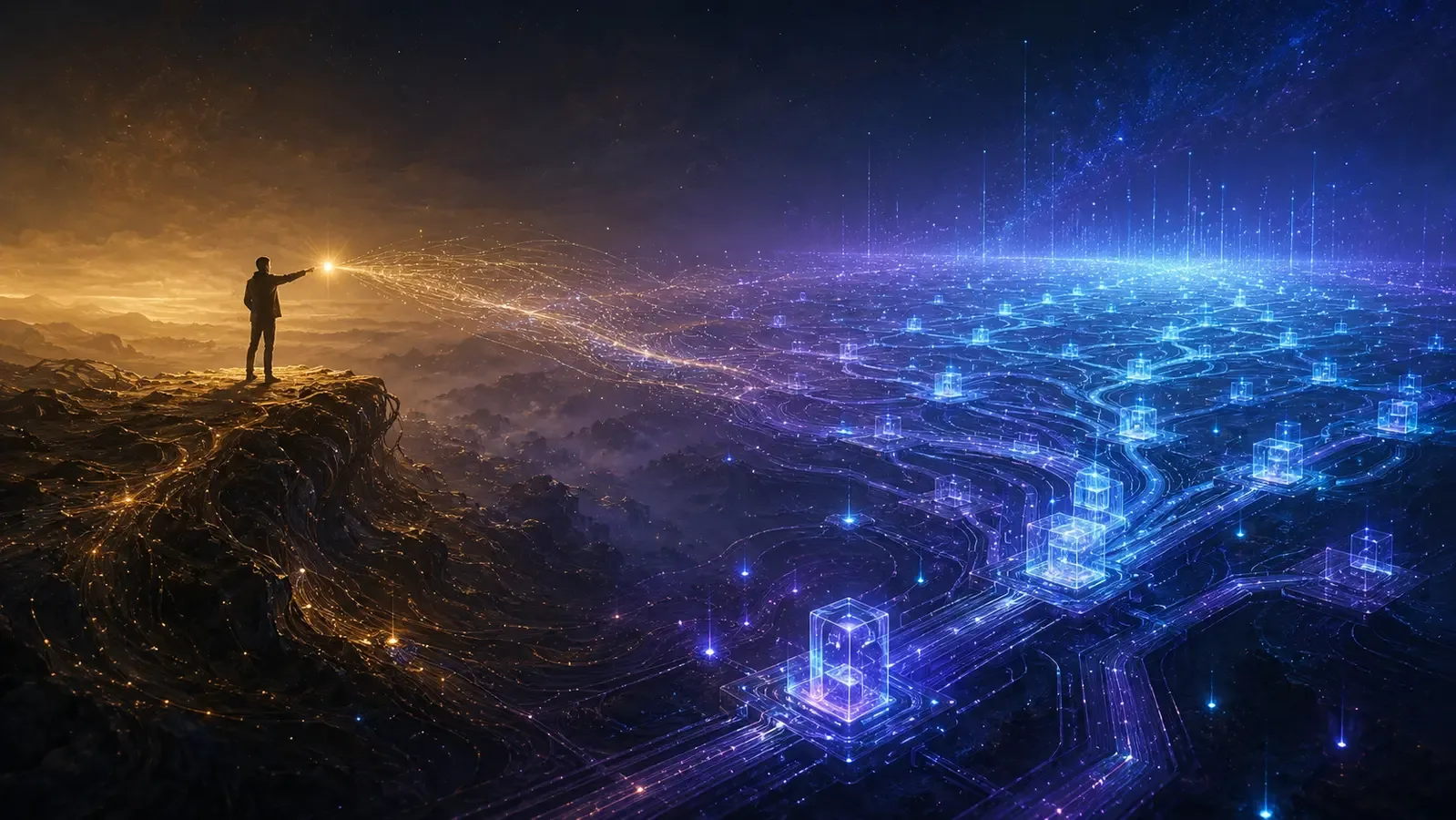
Carbon decides which frontier is worth pursuing. Silicon helps us cross it.
That is not a claim that AI will never originate an idea—that would be an unnecessarily permanent claim based on temporary systems. It is a claim that humanity will not stand still while AI advances. Perhaps future silicon intelligence will one day found fields we cannot yet name. By then, carbon intelligence may be pursuing questions that sound equally meaningless to us now, with AI helping to formulate and solve them, while human experience continues to shape which possibilities are worth pursuing at all.
This is not a metaphysical boundary between human creativity and machine imitation. It is a moving division of labour. As silicon absorbs more of what was once difficult, carbon moves toward questions that were previously unreachable.
A task manager was the wrong answer
I saw this distinction in a much less dramatic setting while working on a system for a university maintenance team.
The initial request was for a task-management application. It sounded straightforward: create recurring inspection tasks, assign them to people, collect evidence, record completion and escalate overdue work.
A capable AI agent could have built that system. Given a detailed specification, it could have created the database, interfaces, permissions, workflows, tests and deployment configuration. It might have done all of this faster and more consistently than a human developer.
It would also have solved the wrong problem perfectly.
The maintenance team did not fundamentally need a better way to manage tasks. They needed to know whether critical equipment across the campus was healthy.
Once that became clear, the system changed. Inspection readings, breakdown history, service schedules and abnormality reports became evidence about equipment health. Sensors such as flow meters on water tanks made actual usage measurable. Technicians logging readings from their phones, users reporting problems as they encountered them and lab test results feeding in alongside them replaced scattered verbal updates with a concrete view of the campus.
Tasks were still necessary, but they were inputs. The real product was an observability dashboard.
This is the part of software engineering that remains hardest to delegate: understanding the real problem behind the requested solution. People often ask for the best answer they can imagine. Building exactly what they requested can produce excellent software that changes nothing.
Once the real problem and the governing approach are understood, however, almost everything else can move toward silicon. Architecture, implementation, testing, deployment, monitoring and even verification are all forms of work that AI can increasingly perform. Verification is not mystical; much of it means comparing results with requirements, testing edge cases and detecting inconsistency. Those abilities will improve too.
The human role moves upward: understand what needs to be done, define what a desirable outcome means, establish the important constraints and then move on to the next unsolved problem.
Capability can be delegated. Because the purpose still comes from us, accountability remains with us.
The compounding loop
The time AI saves does not automatically make humanity wiser. It creates capacity. What happens to that capacity depends on the person and the society around them.
For me, AI reduced the time I spent on routine coding. I used part of that time to learn more about AI. That let me delegate more complex work, which saved more time, which gave me another opportunity to learn.
The loop keeps compounding:
- AI saves time.
- I use the time to understand AI better.
- Better understanding lets me use AI for harder problems.
- AI saves even more time.
Someone else may use the time saved by a robotic cooking assistant to garden, raise a child, rest or learn music. That is not a less valuable use of augmentation. Silicon creates room; carbon decides what the room is for.
The productive unit is therefore not the human or the AI by itself. It is the feedback loop between them.
This is why I see AI primarily as an extension of humanity rather than as a separate civilisation. Calculators extended arithmetic. Computers extended information processing. AI extends our capacity to reason, create and act.
But the loop only compounds for as long as I can access the machine it runs on—and that raises a problem calculators did not create at the same scale.
It is still not Ravi’s AI
I can own a calculator. I can own a computer. Even if their manufacturers disappear, the devices continue to perform most of the functions for which I bought them.
Frontier AI is different.
It is still OpenAI’s AI or Anthropic’s AI—not Ravi’s AI.
I pay for access to intelligence operated on someone else’s infrastructure. Its price, limits, memory, policies and availability can change. A company can weaken a service, discontinue a model, restrict a use case or make the capability too expensive for me. The more I restructure my work around it, the more consequential that dependence becomes.
Open models and local hardware will improve. I may eventually run something comparable to today’s frontier systems privately, retain its context and shape it around my own life. But by then the frontier will have moved. The best available intelligence may continue to require capital, hardware, energy and infrastructure beyond individual ownership. Today’s frontier may become personal; the frontier itself may remain corporate or governmental.
That creates unequal access and dependence at the same time. People with better AI gain more capacity to learn, build and earn, giving them the resources to buy still better AI. Meanwhile, even those with access build their work and intellectual growth around a capability they rent but do not control.
And this leads to the paradox that makes the coming transition frightening:
AI can free people from work, but in the current economic system work is what gives most people the money required to access AI—and the security required to use the time it saves.
If AI removes the job that pays for someone’s augmentation, what exactly has it freed them to do?
The destination may be better than the transition
It is easy to become gloomy when we place advanced AI inside today’s world and change nothing else.
We imagine today’s companies, education systems, ownership structures and job market unchanged, except that millions of tasks can suddenly be performed by machines. In that frozen picture, displacement is the obvious result. But the world will not stay frozen. As implementation becomes cheaper, people will attempt projects that were too expensive, problems that never justified a team will become worth solving, and the definition of valuable human work will change.
But adaptation does not happen at the same speed for everyone.
The old job can disappear before the new role exists. A skill can lose its market value before a worker has the time or money to learn another. Affordable access may arrive after the people who needed it most have already fallen out of the compounding loop.
That transition could be painful even if the destination is better.
I remain cautiously optimistic because I do not see silicon intelligence as a rival species. I see it as humanity building an extension of itself—one that should eventually outperform individual humans across vast areas of thought and execution.
My concern is not that AI will become better than us.
My concern is whether its capability will remain available to us while the world reorganises around it.
Carbon intelligence will continue choosing new frontiers. Silicon intelligence will help us reach them. The future of that relationship will depend less on which one is “more intelligent” and more on whether every human has a fair chance to participate in the loop.
If the intelligence extending humanity never truly belongs to humans, who exactly gets to compound with it?
LogCTL Dispatch
New essays, experiments and workflows. No daily noise.
Usually 2–4 emails a month.
Comments
Loading comments…