The Future of Software Engineering Is an Operating Model
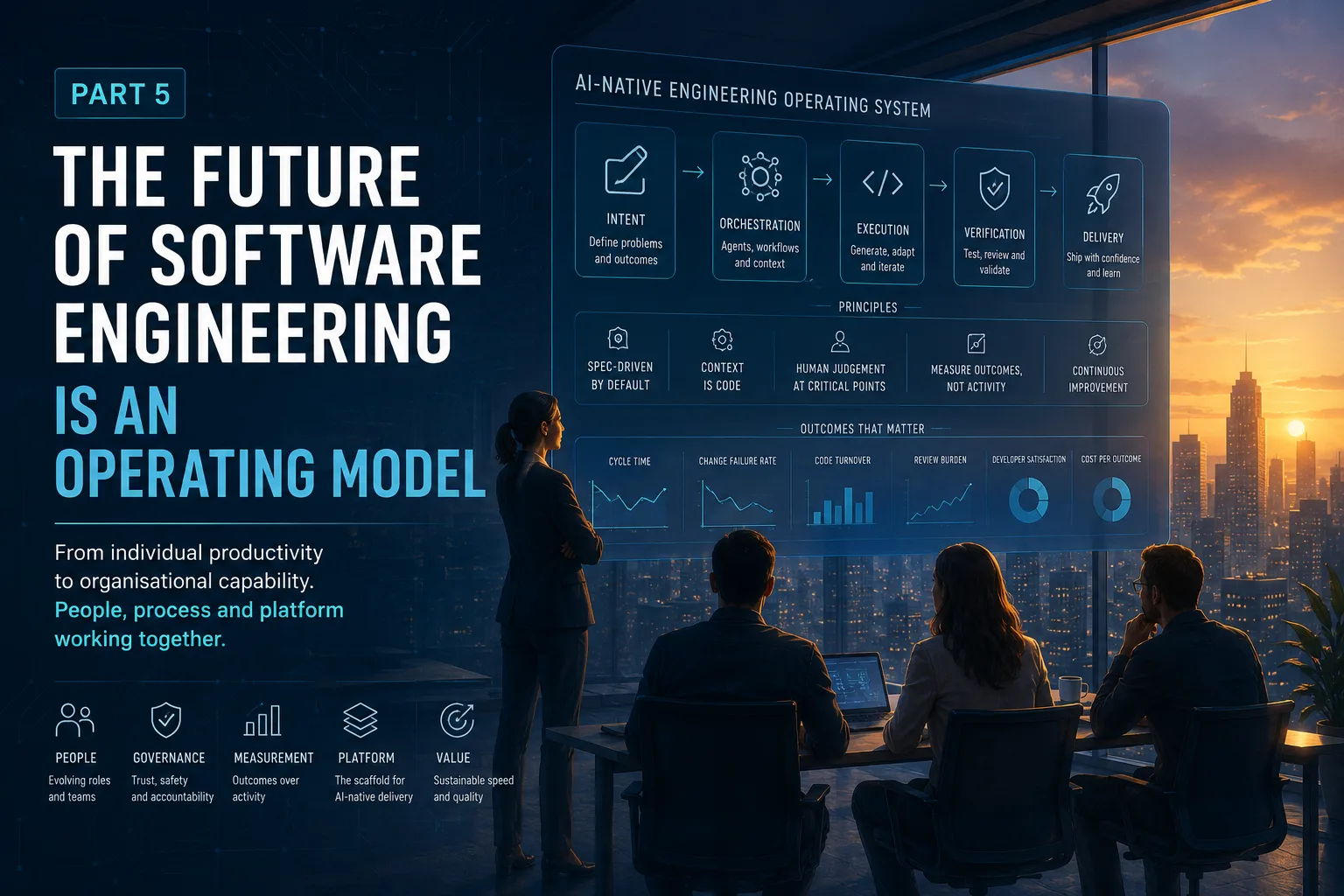
AI-native engineering isn't about removing humans. Part 5: how roles, teams, economics and accountability shift when implementation stops being the main work.
On this page
- Roles will change before they disappear
- The junior pipeline is the most serious people risk
- What a smaller AI-native team actually looks like
- The platform team becomes part of the engineering workforce
- Hiring should test judgement with AI, not without it
- Transformation begins when practices become infrastructure
- Measure outcomes, not AI activity
- Engineering leaders need a new scorecard
- Are we delivering faster?
- Is the output durable?
- Is the human system coping?
- Is the economic model improving?
- Tokens are now part of engineering economics
- Model routing will become an engineering discipline
- Self-hosting is not automatically cheaper
- Some failure modes will improve with the tools
- Other risks are structural
- The future will contain more software, not merely fewer developers
- What should an organisation commit to this quarter?
- Name an accountable owner
- Select one pilot team and one measurable workflow
- Establish a platform budget
- Create a cross-functional working group
- Define the scorecard before expansion
- Protect the talent pipeline
- AI-native engineering is not a tool choice
Part 5 of the LogCTL series on AI-native software engineering
The first four parts of this series followed the evolution of AI-native software engineering from idea to operating system.
We began with the shift in the engineer’s role: away from being the primary producer of code and toward defining intent, supplying context, supervising execution and validating outcomes. We then looked at the productivity evidence and found that faster generation does not automatically produce faster delivery. After that came the practical method: specifications, context engineering, agent loops, execution harnesses and verification. Finally, we examined what happens when one agent becomes many and coordination, governance and review become the real constraints.
The remaining question is organisational.
What happens to engineering roles when implementation is no longer the dominant activity? What happens to team structure when a small group can coordinate far more output than it could manually produce? What should leaders measure? How should they think about cost? And which risks remain even after the tools become significantly better?
These questions matter because AI-native engineering is not merely a new developer workflow. It changes the economics and shape of the software organisation.
The model may generate the code, but the organisation still decides what deserves to exist, how much trust it has earned and who remains accountable for the result.
Roles will change before they disappear
The easiest prediction to make about AI and software engineering is that developers will be replaced.
It is also the least useful.
Some categories of implementation work will almost certainly require fewer people. Routine code generation, straightforward integrations, boilerplate-heavy internal tools and repetitive maintenance are becoming cheaper. Teams that once needed several engineers to keep up with a backlog may eventually need fewer.
But that does not mean the organisation no longer needs engineering capability. It means the work moves.
Someone still has to interpret incomplete requirements, understand the existing system, make architectural decisions, identify risks, validate behaviour and own production outcomes. As agents become more capable, those responsibilities become more concentrated rather than less important.
The research report describes an emerging role progression.
Junior engineers move toward something resembling an AI Reliability Engineer: writing detailed specifications, checking generated output, documenting patterns and learning the codebase through review.
Mid-level engineers become AI Operators: choosing tools, designing agent workflows, managing context and deciding which tasks should be delegated.
Senior engineers become architects, reviewers and governance owners with final authority over consequential decisions.
These titles may not survive. The underlying shift probably will.
The entry-level engineer of the future may spend less time building a CRUD application from scratch and more time evaluating one generated by an agent. They may learn by tracing unfamiliar code, identifying missing tests, checking assumptions against a specification and correcting patterns that do not belong in the repository.
The mid-level engineer may be judged less by how quickly they complete an individual ticket and more by whether they can design a workflow that reliably completes an entire class of tickets.
The senior engineer may spend less time producing implementations and more time shaping the system within which implementations are produced.
This is not the disappearance of coding. It is the expansion of software engineering beyond coding as its primary visible output.
The junior pipeline is the most serious people risk
The shift creates an obvious temptation.
If agents can perform much of the routine work traditionally assigned to junior developers, organisations may stop hiring juniors.
That decision may look rational in the short term. Senior-heavy teams can move quickly, supervise agents effectively and avoid the training cost associated with inexperienced engineers.
The long-term consequence is a talent hollow.
Senior engineers do not appear spontaneously. They become senior by spending years working through systems, making mistakes, reviewing code, observing production failures and gradually developing judgement.
If organisations remove the entry point, they do not eliminate the need for future senior engineers. They eliminate the pipeline that creates them.
The report warns that organisations freezing junior hiring could create an inverted pyramid that becomes unsustainable within three to five years. Its recommendation is not to preserve junior roles unchanged, but to redefine them.
That distinction is important.
The answer is not to keep paying people to write boilerplate simply because previous generations learned that way. The answer is to design entry-level work around the skills the organisation will actually need.
A junior engineer might own the specification and validation of a bounded feature rather than manually implementing the entire feature. They may be responsible for tracing how data moves through the system, identifying undocumented assumptions, improving repository context and reviewing agent-generated tests.
They should still write code.
But code should become one part of a broader learning loop rather than the sole measure of progress.
A useful junior programme in an AI-native organisation would deliberately develop four capabilities:
- understanding unfamiliar systems;
- distinguishing plausible output from correct output;
- writing precise, testable requirements;
- and recognising when uncertainty requires escalation.
These are not easier skills than implementation. In many ways, they are harder to teach because they depend on judgement rather than syntax.
That makes mentorship more important, not less.
What a smaller AI-native team actually looks like
The research report points toward smaller, senior-weighted pods of three to five people replacing some traditional teams of eight to twelve, with reported cycle-time improvements of 40 to 70 percent.
The attraction is obvious.
A small group with strong domain knowledge, reliable agents and a mature platform can coordinate far more output than a similarly sized team could produce manually. Communication overhead falls. Decisions can be made faster. Ownership becomes clearer.
But the structure only works when responsibility is explicit.
Consider a four-person pod responsible for a university admissions platform.
The first member owns product intent and domain specification. They work with admissions stakeholders, clarify business rules and ensure that acceptance criteria reflect the real process rather than a simplified ticket.
The second member owns architecture and agent workflow design. They decide how work should be decomposed, which parts may run in parallel, what repository context must be loaded and where human checkpoints belong.
The third member owns verification and operational quality. They maintain tests, observability, security checks, rollout plans and runtime validation.
The fourth member owns final technical review and production accountability. They resolve architectural disagreements, approve consequential changes and remain responsible for whether the system is safe to ship.
These are not rigid job titles. In a strong pod, responsibilities rotate and overlap. But the accountabilities must exist.
Now imagine the team is implementing a new scholarship-eligibility workflow.
The specification owner defines the eligibility rules, effective dates, exception paths and audit requirements.
The workflow owner divides the work into policy evaluation, administrative review, student communication and reporting, then assigns bounded tasks to agents.
The quality owner defines the test matrix and checks how the rule behaves for historical applications, incomplete records and policy changes.
The final reviewer examines the combined effect across modules and approves the rollout.
Agents may produce much of the implementation. The pod remains responsible for coherence.
This is what smaller teams gain: fewer communication layers and more direct ownership.
It is also what they risk: if one person carries most of the domain or architectural knowledge, the team becomes fast but fragile. If final review depends on a single overloaded senior engineer, machine-generated output can overwhelm the very person responsible for quality.
Smaller teams therefore work only when the organisation around them is stronger.
They need reusable platform capabilities, explicit architectural context, automated quality gates, reliable observability and clear escalation paths. Without those, the team is not lean. It is under-supported.
The platform team becomes part of the engineering workforce
As product teams become smaller, the platform team becomes more important.
Its role is no longer limited to build pipelines, cloud infrastructure and developer environments. It also owns the rails on which agents operate.
That may include:
- approved model access;
- repository context standards;
- reusable agent workflows;
- sandboxed execution environments;
- scoped identities and permissions;
- cost tracking;
- policy enforcement;
- audit logs;
- evaluation systems;
- and standard review gates.
Every product team should not have to invent its own security model, context hierarchy and orchestration framework.
Without a shared platform, adoption fragments. Some teams build sophisticated controls. Others use unrestricted local agents. Context files follow incompatible conventions. Costs become difficult to attribute. Security depends on individual judgement.
A shared platform creates organisational leverage.
Product teams decide what to build.
The platform team determines how safely non-human contributors may participate in building it.
Hiring should test judgement with AI, not without it
Most technical interviews still assume that AI is either prohibited or irrelevant.
Candidates are asked to solve coding problems in an environment unlike the one they will actually use. The organisation then hires them into a workplace where models, agents and automated review are part of daily development.
This mismatch will become harder to justify.
The report recommends allowing candidates to use AI tools and evaluating their judgement rather than pretending the tools do not exist. Useful interview questions include asking when the candidate rejected AI output, whether they can review generated code and whether they can design an evaluation for an AI-produced change.
A good AI-native interview might present a vague requirement and a generated pull request.
The candidate would be asked to identify missing decisions, inspect the implementation, challenge assumptions and design a safer route to production.
The objective would not be to catch whether they used the model too much.
It would be to understand whether they know when not to trust it.
A candidate who generates an answer quickly but cannot explain the failure modes has demonstrated tool fluency, not engineering maturity.
A candidate who slows the process down to clarify a consequential ambiguity may be showing exactly the behaviour the organisation needs.
Transformation begins when practices become infrastructure
Buying tools is easy.
Changing the operating model is not.
The difficult work is not granting developers access to a capable model. It is turning good individual behaviour into a repeatable organisational system.
At first, one engineer writes unusually good specifications.
Then the team notices that certain patterns are repeatedly misunderstood and adds repository context.
Later, agents receive scoped execution environments rather than broad local access. Review gates become standard. Costs are attributed. Governance ownership becomes explicit.
The transformation becomes real when these practices stop depending on a few careful engineers.
A useful specification template becomes part of the delivery workflow.
Context files are reviewed alongside code.
Sandboxes and permissions are provided by the platform rather than configured manually.
Metrics appear in engineering reviews.
Model and agent approvals follow a clear process.
That is the difference between experimentation and capability.
An organisation is not AI-native because some developers can use agents effectively.
It becomes AI-native when reliable use no longer depends on individual improvisation.
Measure outcomes, not AI activity
The perception–reality gap discussed in Part 2 makes measurement non-negotiable.
If developers can feel faster while measured completion time moves in the opposite direction, adoption cannot be judged through enthusiasm alone.
The report recommends outcome-based measures:
- cycle time from idea to production;
- deployment frequency;
- change failure rate;
- and developer satisfaction.
It explicitly warns against lines of AI-generated code, suggestion acceptance rates, raw tool usage and per-task time-saved estimates.
These recommendations need one additional principle.
Every speed metric should be paired with a durability metric.
A team should not celebrate shorter cycle time if the code is rewritten three weeks later. It should not celebrate more deployments if rollback and defect rates rise. It should not celebrate reduced implementation time if review queues become the new bottleneck.
This is why Code Turnover Ratio is useful. It tracks how much merged code is reverted, removed or substantially rewritten within a defined period.
Complexity-Adjusted Throughput adds the other half of the picture by preventing teams from treating every generated pull request as equal progress.
Together, they express a simple idea:
Productivity is not how much code the organisation can produce. It is how much useful change the organisation can produce without borrowing from the future.
The exact formulas matter less than the discipline of pairing velocity with durability.
A team moving quickly and preserving stability has evidence of improvement.
A team moving quickly while churn, duplication and review burden rise has evidence of acceleration, not productivity.
Engineering leaders need a new scorecard
An AI-native engineering scorecard should answer four questions.
Are we delivering faster?
Measure cycle time, deployment frequency and time from specification approval to production.
Is the output durable?
Measure turnover, duplication, architecture violations, defect escape and rollback frequency.
Is the human system coping?
Measure review pickup time, review duration, workload concentration, developer satisfaction and the amount of senior time spent correcting agent output.
Is the economic model improving?
Measure model cost, infrastructure cost, human review cost, failed runs and cost per accepted outcome.
These dimensions should be read together.
Suppose a team reduces implementation time by 60 percent but increases review time by 80 percent. The result may still be positive, but the value is smaller than the generation metric suggests.
Suppose a cheaper model reduces token cost but generates more failed attempts and creates greater review burden. The model is cheaper, but the workflow may be more expensive.
Suppose developers are happier because they no longer perform repetitive work while delivery speed remains roughly unchanged. That may still be a worthwhile result.
Good measurement allows the organisation to recognise these trade-offs without forcing every benefit into a single productivity percentage.
Tokens are now part of engineering economics
AI development tools are often treated like ordinary software subscriptions.
Agentic workflows make the economics more complicated.
The report notes that token prices fell dramatically while total AI spending rose because agent workflows consume far more tokens than simple chat interactions and may run continuously. It estimates that agentic workflows can consume 10 to 20 times more tokens than basic queries, while inference has become the dominant cost centre in enterprise AI budgets.
This creates a familiar cloud-computing problem.
The unit cost becomes cheaper while usage expands faster than the price declines.
A developer asking a model for a function is inexpensive.
An agent inspecting a large repository, generating a plan, editing several files, running tests, retrying failures, summarising context and invoking review agents can consume vastly more compute.
A fleet of always-on agents turns inference into an operational budget.
This does not make agentic development uneconomical. It means the cost must be understood at the level of outcomes.
Raw token counts are not particularly helpful to engineering leaders.
A better measure is cost per accepted pull request, cost per resolved incident, cost per migrated service or cost per successful feature.
The organisation should also include human cost.
A task that consumes ₹500 worth of inference and three hours of senior review may be more expensive than a task using ₹2,000 of inference and twenty minutes of review.
The cheapest model is not necessarily the cheapest workflow.
Model routing will become an engineering discipline
Not every step requires the most capable model available.
A mature workflow may use a frontier model for requirement analysis, decomposition and architectural planning, then route bounded implementation tasks to cheaper models. A specialised model may handle code review, while deterministic tools perform formatting, static analysis and policy checks.
The report suggests that tiered model routing can reduce costs by 60 to 80 percent in suitable workflows.
This resembles workload placement in cloud infrastructure.
Critical, ambiguous work receives expensive capability.
Routine, verifiable work receives cheaper execution.
The difficult part is deciding which tasks belong in which category.
A database migration affecting financial records should not be routed solely according to token price. A documentation update does not need the same reasoning budget as a cross-service architectural change.
Model routing therefore becomes another expression of engineering judgement.
The question is not only, “Which model can do this?”
It is, “What is the cost of being wrong, and how easily can the result be verified?”
Self-hosting is not automatically cheaper
As AI spend grows, teams will naturally consider self-hosted models.
The report suggests that self-hosting may become economically attractive around very high usage levels—roughly 50 to 100 million tokens per month for 70B-class models—although the exact break-even point depends on hardware, utilisation and operational overhead.
The important phrase is operational overhead.
Serving a model is not just renting GPUs.
The organisation must handle capacity planning, batching, latency, upgrades, observability, security, availability and fallback behaviour. Poor utilisation can erase the expected savings. Model quality may also reduce the apparent cost advantage if weaker output requires more retries or human intervention.
Self-hosting makes the most sense when the organisation has sufficient volume, data constraints or latency requirements to justify operating another platform.
It should not be treated as the default symbol of maturity.
A team that cannot measure cost per useful outcome is not ready to optimise inference infrastructure.
Some failure modes will improve with the tools
Not every current problem is permanent.
Models will become better at navigating repositories, preserving intent and working over longer tasks. Context windows, retrieval and tool use will improve. Harnesses will become easier to configure. Agent platforms will develop better isolation, state management and observability.
Some of today’s friction is transitional.
Repeated failure on straightforward tasks may decline.
Spec-driven workflows may become lighter as tools learn to generate and maintain specifications.
Review agents may become better at detecting architectural inconsistency.
The productivity evidence may move decisively positive for broader classes of work.
Teams should expect these improvements.
They should not mistake them for a solution to every problem.
Other risks are structural
The report identifies several open problems that are less likely to disappear merely because models improve: comprehension debt, context rot, specification drift, the junior talent pipeline and long-horizon autonomous reliability.
Comprehension debt is especially important.
A codebase can grow faster than any individual’s ability to understand it. Agents may continue modifying the system because each local task is feasible, even while the global structure becomes opaque to the humans responsible for it.
This is different from ordinary technical debt.
Technical debt describes design choices that make future change more expensive.
Comprehension debt describes a system that continues to function even though nobody can confidently explain how its important parts fit together.
Better models may help humans query such systems.
They may also accelerate the rate at which the debt accumulates.
Context rot is similarly structural. Organisational conventions change. If context files, examples and policies are not updated, agents will apply outdated rules with increasing consistency.
Specification drift appears when implementation changes faster than the documents intended to govern it.
The talent-pipeline risk remains even if agents become excellent, because organisations will still need people capable of owning systems in the future.
These are not bugs in a particular model.
They are consequences of the operating model.
The future will contain more software, not merely fewer developers
The effect of AI on software employment cannot be understood only by asking how many engineers are required to build today’s systems.
Lower implementation cost changes demand.
Organisations will build internal tools that were previously too expensive. Small teams will attempt products that once required large funding rounds. Legacy systems that were tolerated for years may finally be migrated. Custom software may replace spreadsheets and manual processes in domains that could never justify traditional development.
This expansion will create new work even as individual tasks require less manual effort.
The outcome is unlikely to be a simple one-to-one replacement of developers with agents.
Some companies will reduce engineering headcount.
Others will keep similar teams and increase output.
New businesses will become possible because the cost of software creation falls.
The total volume of software may grow faster than the number of engineers declines.
That does not guarantee that every current role survives.
It does suggest that the future of software engineering will be determined by both automation and expanding demand.
What should an organisation commit to this quarter?
The first part of this series ended with changes an engineer or team could make on Monday.
The final step must be larger.
An organisation that wants to move beyond isolated experimentation should make a few explicit commitments.
Name an accountable owner
Assign responsibility for AI-native engineering to a specific leader or platform group.
This owner should coordinate model access, agent policy, security, cost attribution, context standards and evaluation. Governance cannot remain an informal side task shared by everyone and owned by nobody.
Select one pilot team and one measurable workflow
Choose a team with enough engineering maturity to run a meaningful experiment and a workflow narrow enough to evaluate.
The purpose is not to demonstrate that an agent can produce code. It is to learn how specifications, context, review and cost behave inside a real delivery system.
Establish a platform budget
Fund the supporting infrastructure, not only model subscriptions.
This includes sandboxing, identity and permission management, observability, audit logs, evaluation tooling and developer enablement.
Without a platform budget, governance remains aspirational and every team reinvents the same controls.
Create a cross-functional working group
Include engineering, product, security, platform and legal or compliance representatives where relevant.
The group should resolve policies that individual developers cannot decide alone: acceptable data use, approved tools, accountability, procurement, model provenance and production permissions.
Define the scorecard before expansion
Agree on cycle time, review burden, stability, turnover, cost and developer experience before scaling the pilot.
If success is defined only after the results arrive, the organisation will choose the metric that tells the most flattering story.
Protect the talent pipeline
Continue hiring and developing junior engineers, but redesign their work around specification, validation, system understanding and supervised agent use.
The organisation should not optimise one quarter’s productivity by creating a three-year capability gap.
The research report recommends piloting spec-driven development, committing context files, instrumenting delivery metrics and assigning a named governance owner.
At organisational scale, those practices should become funded responsibilities rather than voluntary habits.
AI-native engineering is not a tool choice
The industry conversation still focuses heavily on models.
Which model writes the best code?
Which agent can run the longest?
Which editor provides the best experience?
Which benchmark has the highest score?
These questions matter, but they are not the foundation.
Models will change.
The durable advantage lies elsewhere.
It lies in whether the organisation can express intent precisely.
Whether its repositories contain usable institutional knowledge.
Whether agents operate inside enforceable boundaries.
Whether verification scales with output.
Whether engineering roles evolve without destroying the talent pipeline.
Whether metrics distinguish speed from deferred rework.
Whether costs are attributed to outcomes rather than hidden inside subscriptions.
Whether someone remains accountable when a non-human actor produces the change.
That is the operating model.
AI-native software engineering is not defined by removing humans from software development. It is defined by deciding where human judgement has the greatest leverage and constructing the rest of the system around it.
The machine can generate.
The harness can constrain.
The platform can coordinate.
The tests can verify what has been made explicit.
But the organisation must still decide what is worth building, what evidence is sufficient, what risk is acceptable and who owns the consequences.
That is why AI-native software engineering is not ultimately about AI.
It is about designing a better system for turning human intent into reliable software.
This is Part 5 and the conclusion of the LogCTL series on AI-native software engineering.
LogCTL Dispatch
New essays, experiments and workflows. No daily noise.
Usually 2–4 emails a month.
Comments
Loading comments…