Human-in-the-Loop Is a Lie We Tell Ourselves Before Clicking "Approve All"
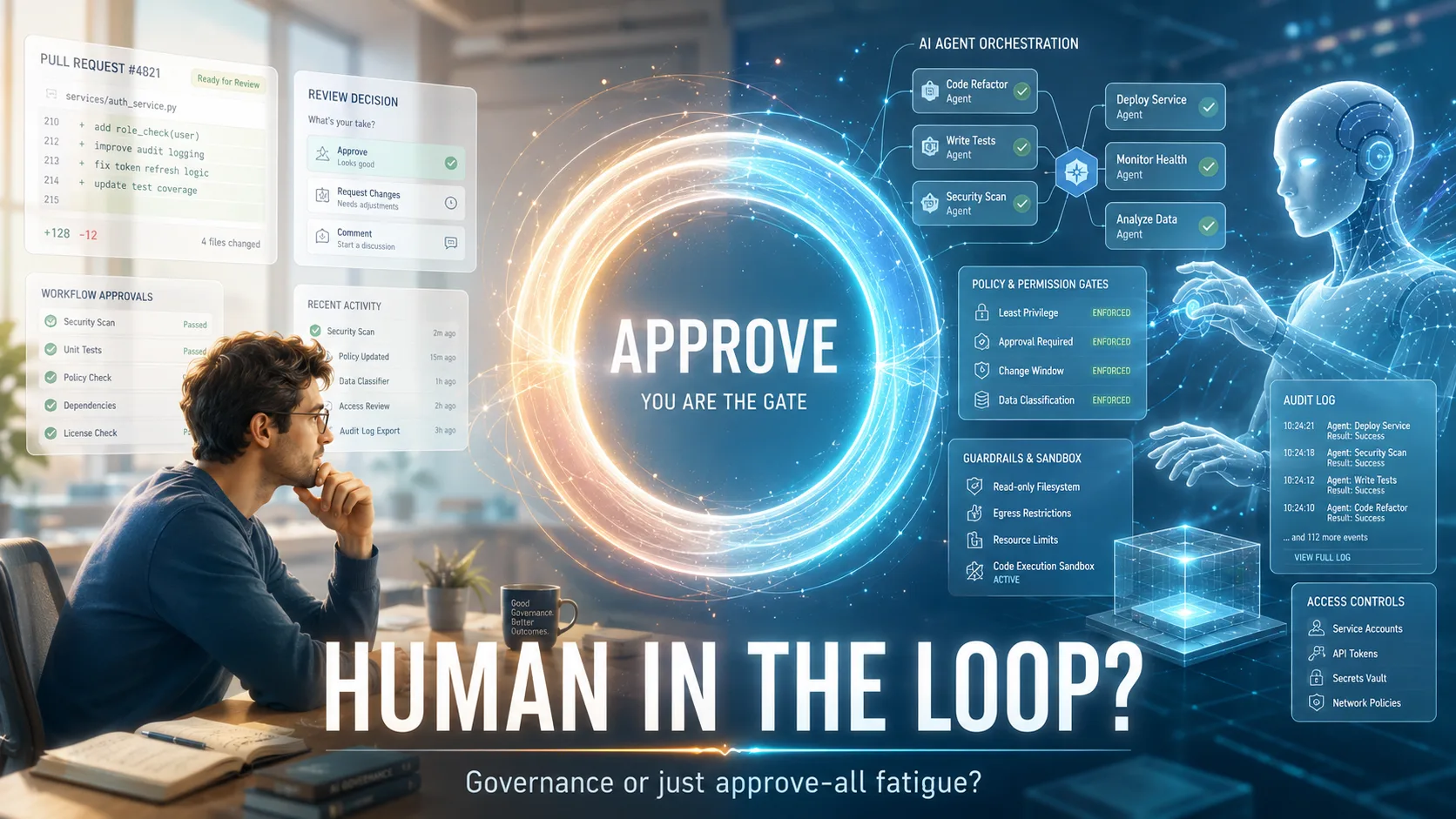
Human-in-the-loop sounds responsible, but tired humans rubber-stamping prompts isn't governance. Real answer: programmatic boundaries, human accountability.
On this page
- The First Week of AI Coding Feels Like a Security Audit
- ”Better AI Code” Also Means “Less Review”, Right?
- AI Agents Cannot Be Governed Like Humans
- Human-in-the-Loop Works Until It Becomes Someone’s Full-Time Boredom
- Human-in-the-Loop Will Probably Stop Being the Default
- Then What Happens to Jobs?
- Will Governments Mandate Human Quotas?
- The Real Future: Boundaries for Machines, Accountability for Humans
- The Uncomfortable Ending
The safest phrase in AI right now is human-in-the-loop.
It sounds mature. Responsible. Enterprise-friendly. The kind of thing you can put in a compliance deck and watch everyone nod like governance has been solved.
“Don’t worry, the AI won’t act alone. There will be a human in the loop.”
Beautiful.
Except there is one tiny problem.
The human in the loop is tired, bored, overloaded, context-switched, and after the 47th approval box, probably just clicking Yes.
Recently, I read an article about Amazon’s stance on human-in-the-loop AI governance. The takeaway was surprisingly blunt: Amazon seems to be moving away from the idea that human review is automatically the gold standard for AI agents.
The argument was simple: AI agents cannot be managed like human employees. A human employee fears real-world consequences. Losing a job. Getting sued. Going to jail. Losing reputation. Being blamed in a meeting.
An AI agent does not care.
It does not fear consequences. It does not feel shame. It does not worry about its appraisal cycle.
So trying to govern AI agents like junior employees is flawed from the beginning.
And honestly?
I think this is painfully true.
The First Week of AI Coding Feels Like a Security Audit
Take a simple software developer using Claude Code, Codex, OpenCode, Cursor, Windsurf, or whatever AI coding tool is trending this week.
In the first week, the developer is careful.
The AI says:
I need permission to edit this file.
The developer checks the file.
The AI says:
I need permission to run tests.
The developer reads the command.
The AI says:
I need permission to update dependencies.
The developer pauses, thinks, maybe even opens the package file.
Everything is reviewed. Everything is inspected. The human is very much “in the loop”.
Then a few weeks pass.
The developer starts trusting the tool.
Then a few months pass.
Now the AI asks:
Can I modify these 19 files, update the database migration, refactor the auth flow, delete unused code, run a command, and restart the service?
And the developer goes:
Yeah, yeah, whatever. Approved.
That is not governance.
That is muscle memory.
At some point, the human-in-the-loop becomes the human-in-the-way. And once that feeling sets in, the human either starts approving blindly or removes the loop entirely.
Let’s be honest. Many of us have already done it.
Claude has a --dangerously-skip-permissions mode for a reason. People use it because approval prompts become friction. And when a tool is valuable enough, humans always try to remove friction.
This is not some moral failure.
It is just how people behave.
”Better AI Code” Also Means “Less Review”, Right?
There is another funny contradiction in the AI coding world.
Everywhere you look, there are GitHub repos, blog posts, prompt libraries, workflow templates, MCP servers, and agent frameworks telling you how to produce better code with AI.
Better prompts.
Better planning.
Better context.
Better repo indexing.
Better test generation.
Better autonomous workflows.
But what does “better” usually mean in practice?
It means the output needs less correction.
And if the output needs less correction, the human reviews less deeply.
That is the whole dream, right?
We want AI that produces code so good that we do not have to babysit it. We want the agent to understand the architecture, follow conventions, write tests, update docs, and ship a clean PR.
But then we also say:
No no, human-in-the-loop will keep everything safe.
Which one is it?
Do we want AI agents powerful enough to work independently, or do we want humans to inspect every meaningful action?
Because those two ideas do not scale together.
AI Agents Cannot Be Governed Like Humans
A junior developer has incentives.
They care about getting fired. They care about reputation. They care about embarrassment in a code review. They care about salary. They care about future opportunities. They care about not being the person who dropped the production database.
An AI agent does not care.
It does not feel career risk.
It does not feel shame.
It does not fear jail.
It does not fear being removed from Slack.
It does not even understand consequence in the human sense.
So when we say “let’s manage AI agents like employees”, we are already making a category mistake.
An agent should not be governed by hope, trust, vibes, or a tired human clicking approve.
It should be governed by boundaries.
Not:
Please don’t delete production.
But:
This identity cannot delete production.
Not:
Ask Ravi before touching billing.
But:
This agent has read-only access to billing unless a signed, scoped, time-limited policy allows one specific operation.
Not:
Be careful with customer data.
But:
This workflow cannot access customer PII unless the task, role, audit policy, and data classification allow it.
That is real governance.
Programmatic boundaries. Scoped permissions. Sandboxes. Rate limits. Immutable logs. Dry runs. Approval only for genuinely exceptional decisions. Rollback paths. Human accountability at the system level.
Not a poor human forced to approve 300 tiny decisions per day.
Human-in-the-Loop Works Until It Becomes Someone’s Full-Time Boredom
The biggest issue with human-in-the-loop is not that humans are useless.
Humans are extremely useful.
The problem is that we keep placing humans at the worst possible point in the system.
Imagine a person assigned to approve actions for one narrow AI use case.
Most of the time, they sit idle.
Then suddenly the agent needs approval.
They review it.
Then nothing.
Then another approval.
Then nothing.
This is boring, fragmented work. It is not deep work. It is not ownership. It is not strategy.
It is sitting at a toll booth for an AI system.
Now imagine the company says:
This is inefficient. Let’s have one human supervise many agents across many use cases.
That sounds better on paper.
But now the human is watching ten workflows, twenty agents, fifty approval streams, hundreds of small decisions, all with different context.
What happens next?
They approve everything.
Not because they are stupid.
Because no human can maintain deep context across that many fast-moving agentic workflows.
At that point, human-in-the-loop becomes performative compliance.
The company gets to say “a human approved it”.
The human gets to say “the system asked me”.
The agent gets to continue doing whatever it was doing.
And when something breaks, everyone points at the audit log.
Human-in-the-Loop Will Probably Stop Being the Default
I strongly believe human-in-the-loop will stop being the default design principle for most AI automation.
Not today.
Not everywhere.
Not immediately in high-risk domains.
But directionally, yes.
Because humans cannot keep up with AI speed.
A human cannot review every generated line of code.
A human cannot approve every database query.
A human cannot inspect every infrastructure change.
A human cannot manually validate every support response, every report, every generated test, every deployment step, every alert summary.
The whole economic value of agents is that they operate faster than humans.
So if every important action needs a human approval, you have not built an agent.
You have built an intern with a very expensive autocomplete engine.
The future is more likely to be:
Human-on-the-loop, not human-in-the-loop.
Humans define the goal.
Humans define the boundaries.
Humans define unacceptable outcomes.
Humans review samples, metrics, failures, incidents, and drift.
Humans improve the system.
Humans remain accountable.
But humans do not approve every button click.
Then What Happens to Jobs?
This is the uncomfortable part.
If human-in-the-loop goes away, many jobs built around review, approval, coordination, repetitive judgment, and low-context execution will shrink.
Not all at once.
Not evenly.
Not cleanly.
But it will happen.
And the standard answer is:
Humans will move to higher-value work.
Which is true for some people and painfully false for others.
Some developers will become system designers, reviewers of architecture, AI workflow builders, evaluators, security thinkers, product engineers, and domain experts.
Some operations people will become automation designers.
Some managers will become accountability owners rather than task routers.
But many people will simply be asked to do more with fewer people.
That is the part the industry does not like saying loudly.
AI does not just remove boring work. It also removes the entry-level ladder that helped people become good enough to do higher-level work.
If juniors do not write basic CRUD, how do they learn architecture?
If developers do not debug boring production issues, how do they learn systems thinking?
If analysts do not clean messy data, how do they learn where data lies?
If support teams do not handle repetitive tickets, how do they learn customer pain?
We are automating not just work, but apprenticeship.
That is dangerous.
Will Governments Mandate Human Quotas?
At some point, regulation will enter the room.
Maybe not in the form of “one human per AI agent”.
But some form of labor protection or AI deployment reporting feels inevitable.
Could a law say companies must maintain a certain percentage of human workers?
Maybe.
Could a sector say critical decisions must always have human accountability?
Definitely.
Could governments demand disclosure when AI agents replace human roles?
Probably.
Could there be rules around how many AI agents a company can deploy relative to employees?
Possible, but messy.
The problem is that an AI agent is not like a robot in a factory. It is not a visible machine standing on the floor.
It could be a script, a workflow, a browser agent, a code agent, a sales assistant, a support bot, a data pipeline, or a hundred tiny automations stitched together.
How do you count that?
Is one agent equal to one employee?
What about an agent that works 24/7?
What about 1,000 small agents that each do one task?
What about an LLM embedded inside an existing SaaS tool?
Regulation will struggle because AI labor is not physically countable.
But governments may still try because the social pressure will be real.
The Real Future: Boundaries for Machines, Accountability for Humans
So is human-in-the-loop good or bad?
It is good when the human is making a meaningful judgment.
It is bad when the human is just a compliance checkbox.
It is good when the decision is rare, high-context, and consequential.
It is bad when the decision is repetitive, low-context, and high-volume.
It is good when the human has enough time, information, and authority to say no.
It is bad when the human is overloaded, rushed, and punished for slowing things down.
Human-in-the-loop should not disappear completely.
But it should stop being treated as magic governance dust.
For agentic AI, the better model is:
- Programmatic boundaries for what the agent can do
- Scoped access based on task and intent
- Separate identities for agents
- Full audit trails
- Sandboxed execution
- Automated tests and evals
- Rate limits and blast-radius limits
- Human accountability for the system
- Human review for exceptions, not every tiny action
The human should design the game, not approve every move.
The Uncomfortable Ending
We invented programming languages because humans needed abstraction.
Maybe AI will keep using those abstractions because human-readable code is still useful for collaboration, review, and maintenance.
Or maybe, one day, machines will generate software in forms that are less and less designed for human eyes.
I do not know exactly how far that goes.
But I do know this:
Humans cannot remain the bottleneck forever.
Not in coding.
Not in operations.
Not in automation.
Not in decision-making.
The comforting story is that there will always be a human in the loop.
The more realistic story is that humans will move out of the loop and into system design, governance, accountability, direction, and exception handling.
That future may be more efficient.
It may also be more unequal, more fragile, and harder to regulate.
So maybe the real question is not:
Should we keep humans in the loop?
The real question is:
What should humans still be responsible for when they are no longer fast enough to supervise the machine?
Because the loop is already breaking.
We are just still pretending the approval button means control.
LogCTL Dispatch
New essays, experiments and workflows. No daily noise.
Usually 2–4 emails a month.
Comments
Loading comments…