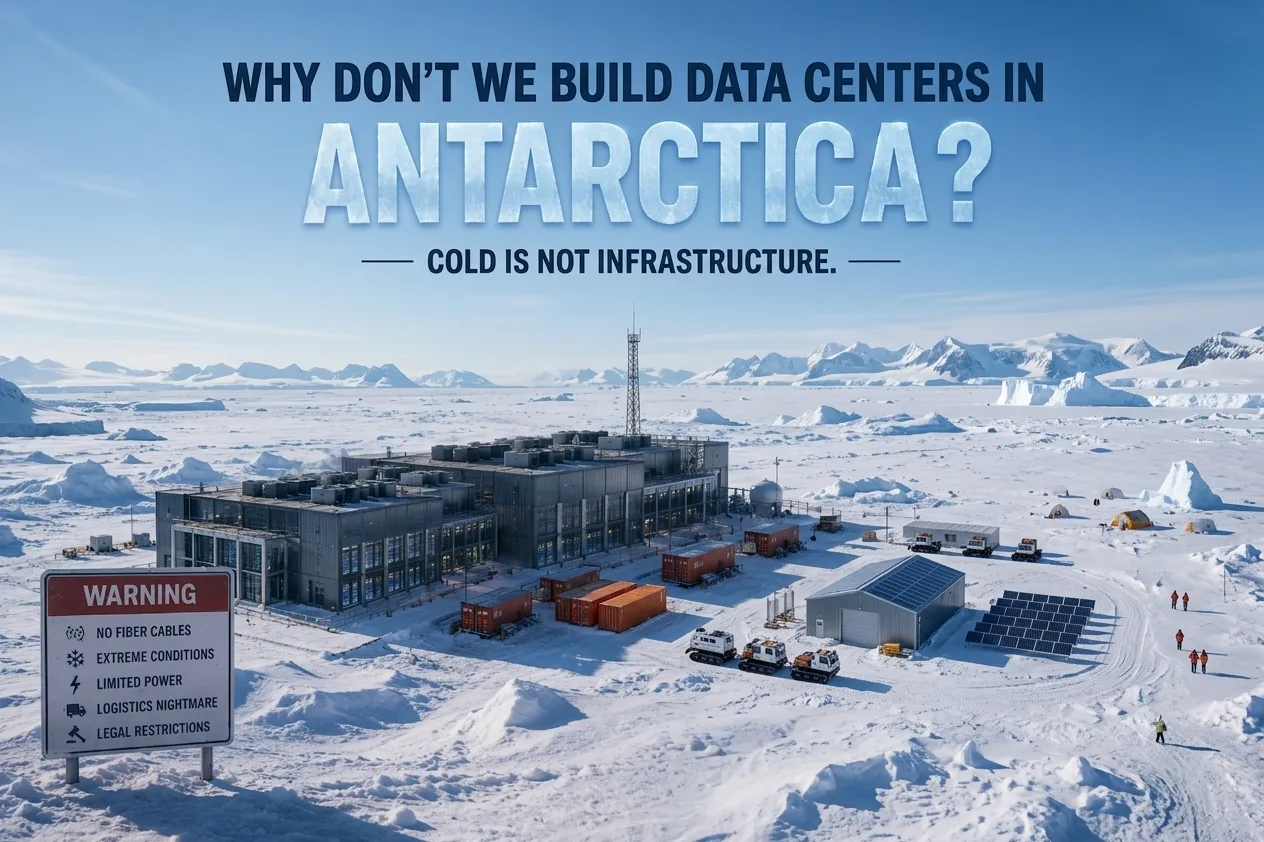
Why Don't We Build Data Centers in Antarctica?
Antarctica is cold, so why no data centers? Because data centers are factories, and factories need power, fiber, roads, spare parts, workers and permits.
On this page
- Cold Is Not Infrastructure
- The “Free Cooling” Myth
- Power Is the Real Problem
- A Data Center Without Fiber Is Just an Expensive Heater
- The Spare Parts Problem
- People Forget the Humans
- The Ground Is Not a Parking Lot
- The Legal Wall
- Waste Heat Is Not Harmless
- So Where Should Cold Data Centers Go?
- The Real Answer
Every few months, someone asks the same question:
“If data centers need cooling, why don’t we just build them in Antarctica?”
At first glance, it sounds brilliant.
Data centers are hot. Antarctica is cold. Cooling is expensive. Antarctica is basically a freezer the size of a continent.
Problem solved.
Except, of course, infrastructure does not work like a shower thought.
Data centers do not run on cold air alone. They run on power, fiber, roads, spare parts, technicians, permits, fire safety, logistics, and the ability to fix broken things quickly.
Antarctica gives you cold.
Then it takes almost everything else away.
Cold Is Not Infrastructure
The biggest misunderstanding is assuming that cooling is the whole data center problem.
It is not.
Cooling matters, obviously. Data centers consume enormous amounts of electricity, and a large part of facility design is about moving heat away from servers safely and efficiently.
But a data center also needs:
- cheap, stable electricity
- high-capacity internet connectivity
- physical access
- stable land
- spare parts
- trained technicians
- fire response
- security
- legal permissions
- environmental clearance
- redundancy
- maintenance contracts
That is why data centers are built in places like Norway, Finland, Sweden, Iceland, Canada, and parts of the United States.
Not because those places are just cold.
But because they are cold and connected and powered and politically usable and maintainable.
Cold weather is useful.
It is not the business model.
The “Free Cooling” Myth
Antarctica is cold, yes.
Too cold, in fact.
Servers are not magical metal bricks that can be exposed to raw polar air. They need controlled temperature, controlled humidity, stable airflow, clean air, and protection from condensation, static discharge, dust, ice, and sudden thermal changes.
You cannot simply open a giant vent and let Antarctic wind blast through GPU racks.
That air would need to be filtered, mixed, conditioned, humidified or dehumidified depending on the situation, and carefully controlled before it ever touched the hardware.
Extreme cold does not remove engineering.
It replaces one engineering problem with another.
Instead of asking, “How do we cool this room?”
You are now asking, “How do we safely convert brutal outdoor cold into stable indoor cooling without damaging millions of dollars of hardware?”
That is not free cooling.
That is a very expensive HVAC system wearing a parka.
Power Is the Real Problem
Even if cooling were magically solved, the bigger question appears immediately:
Where does the electricity come from?
Modern data centers are not small server rooms. AI data centers especially are industrial-scale power consumers. They can need as much electricity as towns, cities, or large manufacturing zones.
Antarctica does not have a convenient power grid waiting for Microsoft, Google, Amazon, Meta, or OpenAI to plug into.
There is no nearby hydroelectric surplus. No regional transmission network. No normal power market. No industrial estate with substations and contracts ready to go.
Research stations survive through careful planning, imported fuel, limited renewables, and tightly managed logistics.
A hyperscale data center would need its own power generation, fuel storage, backup systems, electrical distribution, safety systems, and maintenance crews.
At that point, the question is no longer:
“Can we cool servers in Antarctica?”
The question becomes:
“Can we build and operate a massive industrial power facility in one of the most remote and protected places on Earth, then attach a data center to it?”
That sounds much less elegant.
Because cold is a discount.
Power is the business.
A Data Center Without Fiber Is Just an Expensive Heater
A data center is only useful if it can move data.
That means serious connectivity.
Not “some internet.”
Not “a satellite link.”
Fiber.
Massive, boring, beautiful fiber.
Cloud regions need huge bandwidth, redundant routes, low-latency links, peering arrangements, carrier access, monitoring, failover, and repairability.
Antarctica is not sitting in the middle of the global internet backbone. It is physically isolated from almost every major population center, enterprise network, cloud region, and financial system.
Satellite internet is useful for researchers. It can improve communication, email, video calls, and scientific data transfer.
But there is a big difference between:
“Can a research station get decent internet?”
And:
“Can we run a commercial AI cloud region from the bottom of the planet?”
A hyperscale data center does not sip bandwidth.
It eats bandwidth continuously.
Even if someone laid a dedicated submarine cable to Antarctica, that cable would still be a nightmare to protect and repair. Antarctic waters are not friendly to cable ships. Ice, storms, distance, and seasonal access would turn every break into a serious event.
A disconnected data center is not futuristic.
It is expensive furniture.
The Spare Parts Problem
Data centers fail in boring ways.
Power supplies die. Fans fail. Drives fail. Pumps leak. Batteries degrade. Switches burn out. Cables break. Filters clog. Fire systems need testing. Generators need servicing. Firmware updates go wrong. Transformers require inspection.
In a normal location, this is annoying but manageable.
You call a vendor. Parts arrive. Technicians come. Maintenance windows are scheduled. Roads exist. Airports exist. Warehouses exist. Contracts exist.
In Antarctica, every failed component becomes a logistics operation.
Can the part be shipped?
Can it be flown?
Is the runway usable?
Is it the right season?
Can people reach the site?
What if it fails during winter?
What if the specialist is not on the continent?
Cloud infrastructure depends on boring reliability.
Antarctica turns boring reliability into expedition planning.
Amazon Prime does not deliver to the ice sheet.
People Forget the Humans
Even the most automated data center needs people.
Technicians. Electricians. Network engineers. Facility managers. Safety teams. Security teams. Mechanical engineers. Fire suppression specialists. Logistics crews.
And those people need housing, food, water, medical support, transport, communications, emergency planning, and evacuation options.
Now imagine doing all of this through Antarctic winter.
You cannot treat humans like Docker containers and simply schedule them into the polar night.
Once you add the people, you are not just building a data center.
You are building a small industrial settlement.
For what?
Slightly cheaper cooling?
This is where the spreadsheet should quietly close itself.
The Ground Is Not a Parking Lot
People imagine Antarctica as empty land.
But “empty” does not mean “usable.”
Much of Antarctica is ice, snow, glaciers, unstable terrain, protected coastline, or environmentally sensitive land. Ice moves. Weather destroys. Foundations become complicated. Construction windows are limited.
Data centers like boring ground.
Flat, stable, serviceable, permitted, surveyed ground.
They are meant to run for decades. They need stable foundations, predictable access, and infrastructure around them.
Antarctica specializes in reminding humans that “permanent structure” is often just a temporary opinion.
Even if you find a technically suitable place, you still need to bring in construction materials, heavy machinery, fuel, power equipment, networking equipment, people, and emergency infrastructure.
At that point you are not using Antarctica.
You are fighting it.
The Legal Wall
Antarctica is not normal real estate.
No company can simply buy land and launch “AWS South Pole Region.”
The Antarctic Treaty System exists to keep the continent dedicated to peace, science, and environmental protection. It is not designed to support hyperscale private industrial development.
This does not mean every non-scientific activity is impossible. Tourism exists. Private logistics exist. Support operations exist.
But a massive commercial data center is a completely different category.
It would require construction, power generation, fuel storage, long-term occupation, waste handling, environmental assessment, and political acceptance at a very large scale.
That would immediately raise serious legal and geopolitical concerns.
And rightly so.
The whole point of Antarctica’s governance model is to prevent the continent from becoming another industrial battlefield.
A commercial AI data center would bring exactly the type of pressure Antarctica was protected from: private exploitation, environmental risk, territorial tension, and infrastructure creep.
So no, there is no simple path where a tech company signs a lease, pours concrete, and starts training models next to penguins.
Waste Heat Is Not Harmless
A data center does not destroy heat.
It moves heat.
Every watt that goes into compute eventually becomes heat. In normal locations, that heat is dumped into air, water, cooling systems, or sometimes reused for nearby buildings.
In Antarctica, dumping huge amounts of artificial heat into a fragile frozen environment is not neutral.
At small scale, maybe this can be managed.
At hyperscale, it becomes a real environmental question.
What happens to local ice?
What happens to the surrounding air?
What happens to melt patterns?
What happens to nearby ecosystems?
People imagine Antarctica cooling the data center.
But the data center would also be heating Antarctica.
A large AI data center there would not be “using the cold.”
It would be importing an artificial volcano into a protected freezer.
So Where Should Cold Data Centers Go?
The sensible version of this idea already exists.
Build data centers in colder regions that also have:
- renewable or cheap power
- strong grids
- fiber connectivity
- political stability
- usable land
- transport access
- skilled workers
- legal clarity
- repair infrastructure
That is why Nordic countries and other cold, connected regions are attractive.
They offer some of the cooling advantage without deleting the rest of civilization.
Antarctica is not attractive because it is too extreme.
And infrastructure hates extremes.
The Real Answer
So why don’t we build data centers in Antarctica?
Because data centers are not just hot rooms.
They are factories.
And factories need boring things.
Roads. Fiber. Power. Workers. Spare parts. Fire safety. Permits. Maintenance contracts. Emergency response. Legal ownership. Waste handling. Someone who can replace a failed pump without mounting a polar expedition.
Cold helps.
But cold is not infrastructure.
That is the real lesson.
The cloud may feel weightless when we use it.
But underneath, it is still very physical.
And physical things prefer boring places.
LogCTL Dispatch
New essays, experiments and workflows. No daily noise.
Usually 2–4 emails a month.
Comments
Loading comments…