Why Don't We Build Data Centers in Space?
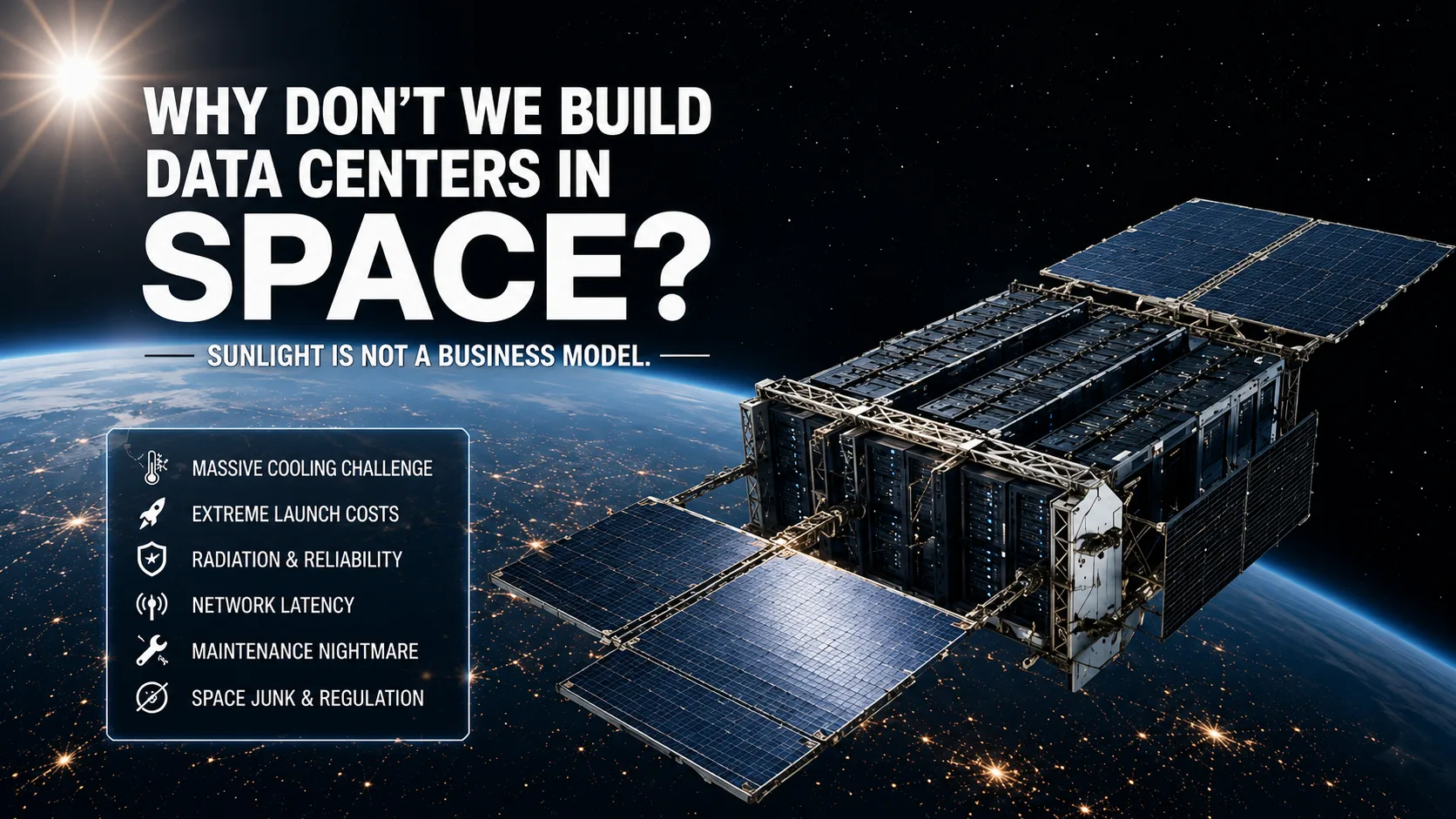
Free solar, no land disputes, no cooling towers. But space removes almost everything a data center needs: easy cooling, maintenance, upgrades and repair.
On this page
- Space Is Cold, But It Cannot Cool You
- Solar Panels Want the Sun. Radiators Hate the Sun.
- The Radiation Tax
- Launch Cost Eats the “Free Solar Power” Argument
- Maintenance Becomes Absurd
- The Network Still Has to Come Back to Earth
- Security Does Not Become Magic
- Space Junk Has an SLA
- Astronomers Are Not Being Dramatic
- The Workload Question
- The Real Future Is More Boring
- The Real Answer
Once people get bored of asking why we do not build data centers in Antarctica, the next idea appears:
“Why not build them in space?”
At first, it sounds even better.
No land problem. No local pollution. Unlimited solar power. No angry residents. No real estate fights. No cooling towers. No water usage. No grid constraints.
Just launch the servers into orbit and let them run on sunlight.
It sounds like the natural endpoint of cloud computing.
The cloud finally becomes an actual cloud.
Unfortunately, space has a habit of turning beautiful ideas into mass, heat, radiation, orbital mechanics, and invoices.
The problem is not that space data centers are impossible forever.
The problem is that hyperscale commercial data centers are not just computers.
They are power plants, cooling systems, networks, maintenance operations, security systems, and supply chains.
On Earth, all of that is difficult.
In space, all of that becomes ridiculous.
Space Is Cold, But It Cannot Cool You
The first misunderstanding is cooling.
People think space is cold, so cooling should be easy.
But space is not cold like Antarctica is cold.
Antarctica has air. Wind. Snow. Ice. Matter.
Space is mostly empty.
That emptiness is the problem.
On Earth, heat can leave a system through conduction, convection, and radiation.
In plain language:
- heat can move through solid materials
- heat can be carried away by air or liquid
- heat can radiate away as infrared energy
In space, there is no surrounding air or water to carry heat away.
So convection is gone.
A chip cannot hand its heat to passing air molecules because there are no passing air molecules.
The final way to dump heat is radiation.
You have to glow the heat away.
Radiation works. Spacecraft use it. Satellites use it. The International Space Station uses it.
But radiation is slow and area-hungry.
That means radiators.
Lots of radiators.
For small spacecraft, fine.
For a serious AI compute cluster, horrifying.
Every watt consumed by a GPU eventually becomes heat. On Earth, we already need complex cooling systems to manage this. Liquid cooling, chillers, airflow design, cooling towers, water systems, heat exchangers — all of this exists because dense compute gets brutally hot.
In orbit, the heat still exists.
But now you need large radiator surfaces, thermal loops, pumps, shielding, orientation control, redundancy, and mass.
The phrase “space is cold” hides the real problem:
Space is cold, but it is terrible at taking your heat away.
Solar Panels Want the Sun. Radiators Hate the Sun.
A space data center has a funny design conflict.
Solar panels need to face the sun.
Radiators need to avoid the sun.
Solar panels are there to collect energy. Radiators are there to reject heat into deep space. If sunlight hits the radiator, it becomes less effective because the thing meant to dump heat starts absorbing energy.
So the spacecraft has to constantly manage orientation.
The solar arrays must track the sun.
The radiators must face cold, dark space.
The communication systems must point toward Earth or relay satellites.
The compute module must stay thermally stable.
The batteries must handle eclipse periods.
The whole structure must survive repeated heating and cooling cycles.
This is not impossible.
But it is no longer a data center.
It is a spacecraft, power plant, thermal machine, telecom platform, and server farm glued together.
Then launched on a rocket.
Then expected to work without a technician standing nearby.
The Radiation Tax
On Earth, your GPU has normal problems.
In space, it gets cosmic problems.
Space is full of radiation hazards: cosmic rays, solar storms, charged particles, and high-energy events that normal data center hardware is not designed to handle.
This can cause bit flips, memory errors, electronics degradation, system instability, and hardware damage.
A normal server can live happily in a well-controlled data center.
In orbit, it needs protection.
That means shielding, redundancy, error correction, fault tolerance, hardened design, and careful recovery systems.
All of that adds weight.
And weight is the tax collector of space.
Every kilogram has to be launched. Every shield, radiator, bracket, battery, panel, cable, spare module, and structural component must first escape Earth’s gravity.
On Earth, hardware can be cheap enough to replace.
In space, hardware becomes sacred.
That is not how cloud economics usually works.
Launch Cost Eats the “Free Solar Power” Argument
The strongest pitch for space data centers is simple:
“Electricity will be free.”
Solar power in orbit sounds amazing. No clouds. No night in certain orbits. No local grid constraints. No land disputes. No electricity bills.
But the power is not free if you have to launch the entire power system into orbit.
A space data center is not just chips.
It needs:
- compute hardware
- solar arrays
- radiators
- thermal loops
- batteries
- power electronics
- shielding
- structure
- propulsion
- communication systems
- attitude control
- redundancy
- ground stations
- replacement strategy
On Earth, data centers are expensive, but Earth gives you a lot for free.
Roads. Ports. Cranes. Workers. Fire trucks. Warehouses. Fiber. Power grids. Insurance markets. Maintenance vendors. Gravity. Air.
Space gives you none of that.
So the business model becomes strange.
You are paying a huge upfront cost to maybe save on electricity later.
That can work only if launch costs become extremely low, hardware survives long enough, maintenance is solved, networking works, radiation is handled, cooling scales, and the hardware does not become obsolete too quickly.
That is a lot of “ifs.”
The chips are the valuable part.
The spacecraft is the tax you pay to put those chips somewhere inconvenient.
Maintenance Becomes Absurd
Data centers are not static.
They are constantly maintained, upgraded, repaired, and refreshed.
Drives fail. Power supplies fail. Pumps fail. Cables fail. Networking gear fails. Batteries degrade. Cooling systems need servicing. Firmware updates go wrong. Racks are replaced. GPUs age. Hardware generations move fast.
On Earth, failure is annoying but normal.
A technician opens a ticket, walks to the rack, replaces the part, and moves on with life.
In space, a failed rack is not a ticket.
It is a tombstone.
Unless the system is designed for robotic servicing, modular replacement, docking, or expensive maintenance missions, dead hardware may simply remain dead.
And AI hardware gets old quickly.
A GPU cluster that looks impressive today may look outdated in three years. If it takes massive launch planning to deploy and replace hardware, the economics get ugly fast.
Earth data centers work partly because hardware is disposable.
Space makes hardware precious.
That is a terrible fit for a fast-moving compute industry.
The Network Still Has to Come Back to Earth
A space data center still needs users.
And users are mostly on Earth.
Companies are on Earth. Developers are on Earth. Databases are on Earth. Payment systems are on Earth. Compliance teams are very much on Earth, unfortunately.
So the data has to move back and forth.
That means ground stations, spectrum rights, laser links, radio links, routing, weather issues, redundancy, security, peering, and terrestrial fiber once the signal lands.
Space does not remove the network problem.
It adds another network above the network.
For some workloads, space compute may make sense.
If you are processing satellite imagery before sending results down, local compute in orbit is useful. If you are doing scientific work in space, sure. If you have delayed batch workloads that do not need constant interaction with Earth, maybe.
But that is very different from running a normal commercial cloud region in orbit.
For interactive AI apps, databases, enterprise software, low-latency systems, finance, gaming, real-time collaboration, or anything that depends on quick back-and-forth communication, orbital compute adds pain.
A space data center is not magically close to everyone.
It is equally inconvenient to everyone.
Security Does Not Become Magic
Some people imagine space data centers as more secure because nobody can physically walk into them.
That is only one kind of security.
Yes, physical intrusion becomes harder.
But new attack surfaces appear:
- uplink attacks
- downlink attacks
- signal jamming
- spoofing
- satellite command compromise
- ground station compromise
- supply chain risks
- orbital tracking
- limited emergency recovery
On Earth, if something goes badly wrong, you can physically intervene.
You can isolate hardware, disconnect racks, replace devices, inspect systems, bring in engineers, and lock down facilities.
In space, you mostly have telemetry, remote commands, and hope.
Security does not become easier just because the server is harder to reach.
Sometimes it becomes harder because it is harder for you to reach too.
Space Junk Has an SLA
One experimental space data center is interesting.
Thousands of them become an orbital traffic problem.
Tens of thousands become a planetary governance problem.
Every satellite has to avoid collisions, manage orbit, communicate safely, and eventually deorbit or move away responsibly.
Now imagine data center satellites with large solar arrays, radiator structures, high-bandwidth links, batteries, propulsion, shielding, and complex thermal systems.
What happens when they fail?
What happens when many fail?
Can they deorbit safely?
Do they create debris?
Who is liable if one breaks apart?
What happens if a dead compute satellite becomes another object moving at several kilometers per second?
A failed data center on Earth is an outage.
A failed data center in orbit can become space junk.
That is a very different failure mode.
Astronomers Are Not Being Dramatic
The sky is not empty real estate.
It is shared infrastructure.
Large satellite constellations already worry astronomers because they can leave bright streaks across telescope images. Radio transmissions can interfere with sensitive observations. Even when companies try to reduce the impact, scale changes the problem.
A few satellites are manageable.
Thousands are hard.
Tens or hundreds of thousands become a serious scientific and regulatory issue.
Space data centers would not be tiny silent pebbles.
They would need solar panels, radiators, communication systems, and orbital control. That means reflectivity, signals, and clutter.
The night sky is not just decoration.
It is how we study the universe.
Turning it into an industrial ceiling should not be treated as an obvious next step.
The Workload Question
This is where the discussion needs nuance.
Can computers in space be useful?
Yes.
Can edge compute for satellites make sense?
Yes.
Can scientific missions benefit from more onboard processing?
Absolutely.
Can some delayed, specialized, or space-native workloads run in orbit?
Probably.
But that is not the same as saying hyperscale AI data centers should move to space.
The question is not:
“Can we put computers in orbit?”
Of course we can.
The real question is:
“Can we operate large-scale, economically competitive, maintainable, upgradeable, low-latency, secure, cloud-like infrastructure in orbit?”
That is a much harder question.
And for most commercial workloads, Earth still wins.
Boring Earth.
With roads, technicians, power grids, fiber, spare parts, fire trucks, warehouses, and people who can physically replace a failed component.
The Real Future Is More Boring
The future of data centers is probably not “launch everything into space.”
It is more likely:
- better chips
- better cooling
- more efficient inference
- liquid cooling
- heat reuse
- smarter workload placement
- renewable energy
- grid upgrades
- nuclear power where acceptable
- better utilization
- specialized edge compute
- less wasteful AI usage
Not as dramatic.
Much more useful.
The hard problems in AI infrastructure are not solved by escaping Earth.
They are solved by making the infrastructure less stupid.
The Real Answer
So why don’t we build data centers in space?
Because space gives you sunlight, but takes away almost everything else.
No easy cooling.
No easy maintenance.
No easy upgrades.
No easy networking.
No easy repair.
No easy shielding.
No easy failure recovery.
No easy economics.
Space compute will have its place. Satellites will get smarter. Onboard processing will improve. Scientific and defense systems will use more orbital compute. Maybe one day, if launch becomes cheap enough and servicing becomes routine, larger orbital compute platforms will make sense.
But hyperscale cloud in space is not around the corner.
Because data centers are not just computers.
They are factories.
And factories need boring things.
The cloud may sound weightless.
But it still depends on very physical infrastructure.
And for now, the best place to run physical infrastructure is still the boring old planet with roads.
LogCTL Dispatch
New essays, experiments and workflows. No daily noise.
Usually 2–4 emails a month.
Comments
Loading comments…